Audience research
Part of Audience research for productivity software, from recruitment frame to interviews without selling
Competitor research for productivity software that verifies the supplier behind each name
Research productivity software competitors through verified entities, product records, pricing units, buyer evidence and credible alternatives in England.
Competitor research should explain what a buyer can choose and why one option fits a particular workflow. A search-results list cannot do that. Use this checklist to build an evidence file for an England-focused product without inventing market share, customer outcomes or first-hand tests.
What to take away
- Define the workflow and customer segment before collecting any companies for comparison.
- Verify the legal entity behind each brand using Companies House and trade mark records.
- Link every feature claim to the supplier's current official product or help page.
- Compare the full commercial unit, including migration, configuration, training and usage charges.
- Treat reviews as leads, not performance evidence, and keep named comparisons on editorial hold.
Set the comparison boundary
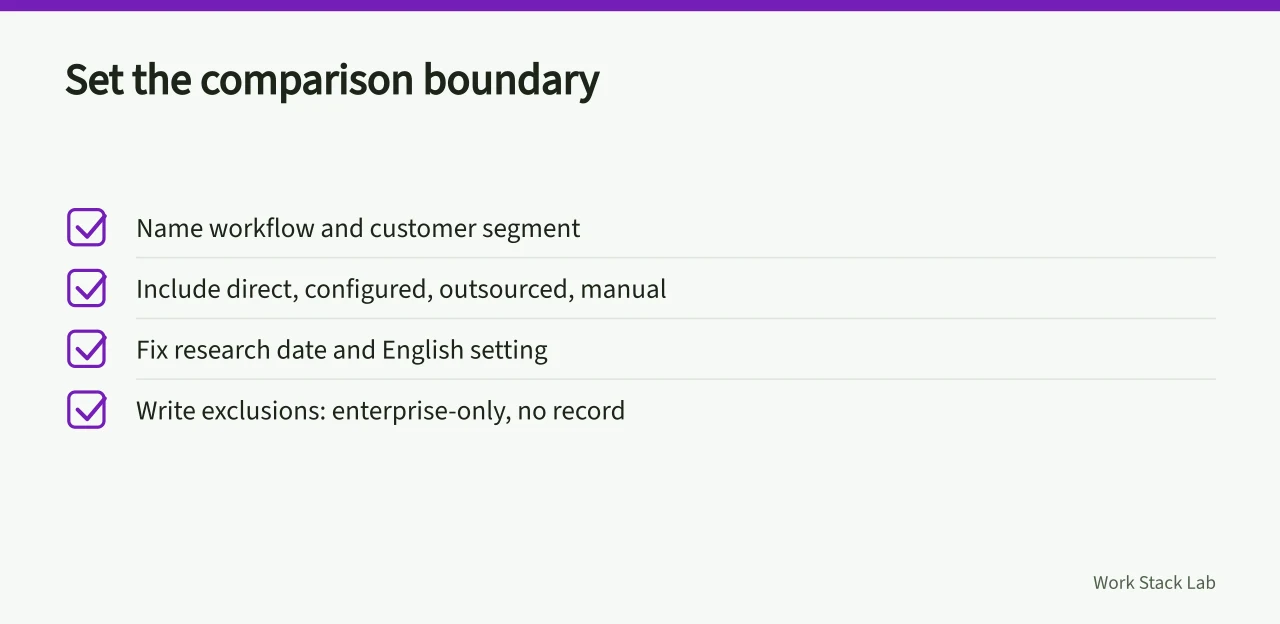
- Name the workflow and customer segment before collecting companies.
- Include direct software, general tools configured for the task, outsourced services and the manual process.
- Fix a research date and state which English buyer setting the work covers.
- Write exclusions, such as enterprise-only contracts or products without an active first-party record.
The Office for National Statistics business activity dataset can help define industry, size and regional context. It does not identify software suppliers' customers or revenue, so it cannot produce a competitive share estimate.
Verify the supplier behind each name
- Record the legal entity shown in terms, privacy material or invoices.
- Check status, officers, filing history and accounts on the official register.
- Note parent companies, acquisitions and trading names without assuming they are the contracting party.
- Search relevant brand names and ownership separately.
Companies House explains that its free register search provides status, filings, officers, charges and insolvency information. The same guidance warns that the service is not comprehensive and that submitted documents do not receive exhaustive verification. The Intellectual Property Office's trade mark search can clarify registered marks, but it does not establish product quality or commercial success.
Verify the supplier entity
- Record legal entity from terms or invoices
- Check status, officers, filing history, accounts
- Note parents, acquisitions, trading names
- Search brand names and ownership separately
Capture current product evidence
- Link each feature claim to the supplier's exact product, help or release page.
- Record whether a capability is standard, restricted to a plan or dependent on another service.
- Note the publication or access date for integrations, limits and security claims.
- Label demonstrations and vendor case studies as first-party material.
If no current official record supports a feature, mark it unresolved. Do not copy comparison-site wording into the evidence table or infer that an old review still describes the product.
Compare the full commercial unit
- Use one workloadusers, sites, records, integrations and support requirement.
- Separate recurring access from migration, configuration, training and usage charges.
- Record contract term, renewal route, notice, export and deletion conditions.
- Do not publish a price from a sales conversation without date, tax treatment and scope.
A free tier and a paid managed service are not like-for-like. Keep unavailable prices blank rather than filling them with an estimate.
Treat reviews as leads
Reviews can suggest questions about support or reliability, but identity, incentives and product version may be unclear. The Competition and Markets Authority's online reviews case page describes current enforcement work and guidance concerning fake or misleading reviews. Do not convert star ratings into performance evidence without a defensible method.
Finish with a buyer decision
For each alternative, write the buyer role, strongest fit, material dependency and unresolved risk. Then identify what must be tested directly, such as an export, permission model or recovery process. The output should change the proposition or research plan, not declare a winner.
Include the option to keep the current process. A shared spreadsheet, outsourced administrator or client-mandated platform may be awkward but still cheaper to change around than to replace. Record the switching work, loss of familiar controls and overlap period. This keeps the comparison anchored to the buyer's actual choice rather than a catalogue of software brands.
Keep named comparisons on editorial hold until every current claim has a first-party source and qualified reviewers have checked commercial and data-protection implications.
Before you act
- Name the workflow and customer segment first.
- Record the legal entity from terms or invoices.
- Check status, officers and filing history on the register.
- Link each feature claim to a current official page.
- Use one workload for all price comparisons.
- Keep named comparisons on editorial hold until verified.
Common questions
How can I verify the supplier behind a software brand?
Record the legal entity shown in terms, privacy material or invoices. Check status, officers, filing history and accounts on the official register. Note parent companies, acquisitions and trading names without assuming they are the contracting party. Search relevant brand names and ownership separately.
What should I do if a feature claim lacks an official source?
Mark it unresolved. Do not copy comparison-site wording into the evidence table or infer that an old review still describes the product. Link each feature claim to the supplier's exact product, help or release page, and record whether a capability is standard, restricted to a plan or dependent on another service.
Why should I include the current process as an option?
A shared spreadsheet, outsourced administrator or client-mandated platform may be awkward but still cheaper to change around than to replace. Record the switching work, loss of familiar controls and overlap period. This keeps the comparison anchored to the buyer's actual choice rather than a catalogue of software brands.