Rules and ethics
Part of UK rules and ethics for productivity software sold in England, mapped before policies
A disclosure policy for productivity software content that records how each claim was made
Write a disclosure policy for productivity software content, covering commercial interests, evidence limits, reviews, automation and security reporting.
A business productivity software disclosure policy should tell a reader who benefits from the content, where its claims came from and which parts were not tested. It also needs an owner who can correct the record. A broad statement in the website footer is weak when a commercial relationship affects one comparison or testimonial.
The method below is for a UK-facing software publisher or supplier. It was prepared on 5 September 2026 and needs advertising, consumer, privacy and security review before use.
What to take away
- A footer statement is too weak when a commercial link affects one comparison or testimonial.
- Record each objective claim's wording, source, calculation, date, configuration and limits, and label desk research, technical checks and testimony separately.
- Say so near a review or comparison when no testing occurred, rather than implying hands-on experience.
- Disclosure does not rescue an unsupported headline, so remove or narrow a claim when evidence does not match.
- Give the policy an owner, review date and correction route, and pause publication when relationship, evidence or test status is unclear.
Inventory material that can influence a decision
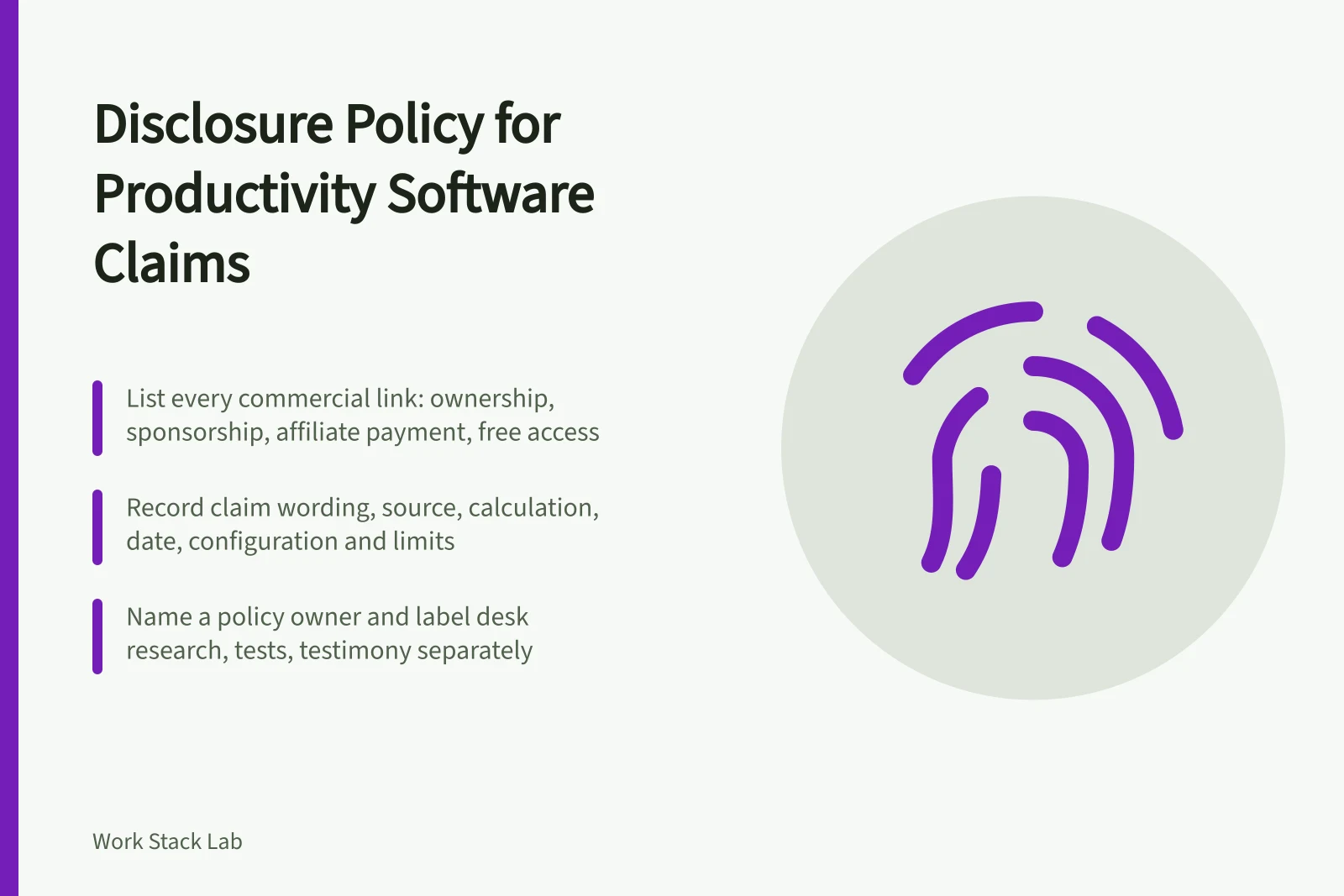
List product pages, comparison tables, reviews, case studies, newsletters, social posts, webinars and sales documents. Add the person responsible and every commercial connection: ownership, sponsorship, affiliate payment, free access, commission, partner status or customer relationship.
Recognition rules in the CAP Code make the presentation of commercial material part of the compliance question. The policy should require a disclosure at the affected content, in words the intended reader can understand. Do not rely on a general policy link to explain a paid placement that otherwise looks independent.
Record how each claim was produced
For an objective statement, keep its precise wording, source, calculation, date, product configuration and limits. Label desk research, a controlled technical check and customer testimony separately. State who performed any real test and what was outside its scope. If no testing occurred, say so near a review or comparison rather than suggesting hands-on experience.
CAP's misleading advertising guidance says marketers should hold evidence for objective claims and consider the overall impression. A disclosure does not rescue an unsupported headline. Remove or narrow the claim when the evidence does not match it.
Set rules for testimonials and reviews
Require the original statement, source contact, permission, date, editing record and incentive. CAP advice on testimonials and endorsements calls for documentary evidence that a testimonial is genuine. Claims contained in it still need assessment.
For consumer reviews, document collection, moderation, publication and incentive handling. The CMA's fake reviews guidance addresses legal duties for businesses that publish consumer reviews and the banned practices introduced in April 2025. A specialist should decide whether a particular enterprise reference, marketplace comment or public review falls within that regime.
Explain automation where it changes meaning
Record whether software generated, summarised, scored or materially edited content. The useful disclosure names the affected output, data source, human review and known limit. Avoid a blanket AI-assisted label that gives no reader enough information to judge a claim.
Where automation evaluates workers or uses personal information, connect the public explanation to the actual privacy assessment. The ICO's worker monitoring guidance stresses purpose, necessity, minimisation and transparency. Marketing wording must not promise anonymity or human control that the product cannot deliver.
Publish security reporting routes carefully
Name a channel for reporting suspected vulnerabilities, the information reporters should provide, expected acknowledgement and safe handling of reports. The government's voluntary Software Security Code of Practice includes publishing an effective vulnerability disclosure process. Claiming to follow the code requires evidence for the relevant principles; it is not government certification.
Make corrections visible
Give the policy an owner, review date and correction route. For a material error, preserve the old claim, change date, reason and affected pages. Update the point-of-use disclosure as well as the central policy. Publication should pause when the relationship, evidence or test status is unclear, because careful wording cannot disclose a fact the team has not established.
Before you act
- List every content type and commercial connection with an owner.
- Disclose at the affected content in plain words.
- Keep evidence for each objective claim and its limits.
- Document testimonial source, permission, date, editing and incentive.
- Record automation, data source, human review and known limit.
- Preserve old claims and reasons for material corrections.
Common questions
What should a disclosure policy say about who benefits from the content?
It should tell a reader who benefits from the content, where its claims came from and which parts were not tested. It also needs an owner who can correct the record. A broad footer statement is weak when a commercial relationship affects one comparison or testimonial.
How should a publisher handle a claim that has no supporting evidence?
CAP's misleading advertising guidance says marketers should hold evidence for objective claims and consider the overall impression. A disclosure does not rescue an unsupported headline. Remove or narrow the claim when the evidence does not match it.
What must be documented for consumer reviews and testimonials?
Require the original statement, source contact, permission, date, editing record and incentive. CAP advice calls for documentary evidence that a testimonial is genuine, and claims inside it still need assessment. For consumer reviews, document collection, moderation, publication and incentive handling.