Rules and ethics
Part of UK rules and ethics for productivity software sold in England, mapped before policies
What an advert for productivity software must be able to prove
Check productivity software advertising for clear commercial intent, evidence, fair comparisons, accurate prices, testimonials and lawful outreach.
Business productivity software advertising rules apply to the impression created by a claim, not only to its literal wording. Before publishing a product page, comparison, case study, paid post or sales email for a UK audience, use the checks below and retain the supporting record. This is a general checklist, not clearance for an advertisement.
What to take away
- Advertising rules judge the impression a claim creates, so a literally true statement can still breach.
- A claim with no dated source, named owner and expiry is not evidenced, however well known the product is to the team.
- A comparison needs a method a reader can follow, not a favourable screenshot.
- A testimonial proves that someone said it, not that the underlying claim is true.
- An advertisement that passes the content checks can still breach the rules on how it is sent.
Mark the communication as marketing
- Can the audience recognise who is advertising and why the material exists?
- Is paid, sponsored or affiliate involvement apparent where the reader encounters it?
- Could the page be mistaken for an official body or neutral comparison service?
The CAP Code puts rules about recognising marketing communications in Section 2 (Recognition of marketing communications). The precise label and prominence depend on the format, so ask an advertising specialist to review ambiguous placements.
Build an evidence file before approval
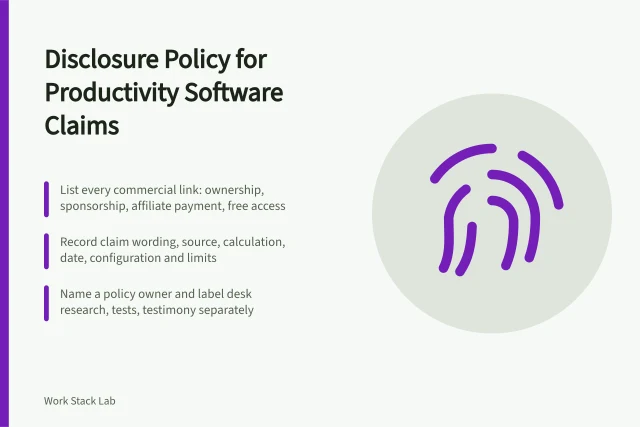
Copy every objective statement into a claim register. Add the audience, evidence owner, source, test configuration, date, exclusions and expiry. Words such as faster, automated, most accurate and saves time can create measurable impressions even without a number.
For the claim 'cuts month-end reporting time', an illustrative register entry would record:
- Audience
- UK operations managers in firms of 50 to 250 staff.
- Source
- a timed internal trial of the current release on a standard sample data set.
- Owner
- head of product marketing.
- Test date
- 12 May 2025. Expiry: 12 November 2025.
- Exclusions
- onboarding and data migration.
CAP Code rule 3.7 requires documentary evidence for claims capable of objective substantiation, and rule 3.1 prohibits marketing communications that materially mislead. CAP's current misleading advertising advice explains how the overall impression is judged. A footnote may clarify a narrow condition. It should not reverse a prominent promise.
Make comparisons reproducible
- Name the plans, versions, features and settings compared.
- Use the same task, unit, date and treatment for each product.
- Provide enough information for the intended audience to check the basis.
- Remove the claim when the source changes or becomes unavailable.
CAP advises that comparisons with identifiable competitors must use material, relevant, representative and verifiable features. Its verifiability guidance also explains how readers should be directed to the methodology. A selected screenshot or unmatched feature table is not a sound basis for a general superiority claim.
Check prices and purchasing conditions
Record who can obtain the displayed price, the billing period, taxes, minimum seats, compulsory setup, renewal basis and material restrictions. A starting price needs conditions close enough to prevent a false impression. Do not turn an illustrative saving into an observed customer result.
The Digital Markets, Competition and Consumers Act 2024 duties cover business-to-consumer conduct, so they are out of scope for this site's audience. The CMA's unfair commercial practices guidance covers misleading actions, omissions and price transparency for that consumer work. Business-to-business marketing sits under the Business Protection from Misleading Marketing Regulations 2008 instead.
Verify testimonials and review material
Keep the source's identity and contact record, permission, original statement, date, incentive and any relevant relationship. Confirm that editing has not changed the meaning. The ASA and CAP guidance on testimonials and endorsements says marketers need documentary evidence that a testimonial is genuine. A customer's quotation does not substantiate a wider technical or performance claim by itself.
If the business publishes consumer reviews, check the CMA's fake reviews guidance. It addresses banned practices introduced in April 2025, including concealed incentivised reviews. Do not imply that the same legal provisions govern an internal enterprise reference call without first classifying the activity.
Review delivery separately
The content of an advertisement and the lawfulness of contacting its recipient are separate matters. The ICO's direct marketing guidance should be applied to the proposed channel, subscriber type and use of personal data.
Sign-off should identify the claim owner, evidence reviewer, legal reviewer, publication date and recheck trigger. Pause release if any prominent assertion lacks a traceable source or the displayed qualification cannot be understood without hunting for it.
Before you act
- Mark the communication clearly as marketing.
- Build an evidence file before approval.
- Make comparisons reproducible and verifiable.
- Record prices and purchasing conditions.
- Verify testimonials and review material.
- Review delivery and direct marketing separately.
Common questions
What must a claim register contain?
Enough for a second reviewer to repeat the test without asking the original author. The register is a working file, not an archive, so entries need a review date as well as a creation date.
When should a comparison claim be removed?
Set the removal trigger when the evidence is collected, because a competitor's update or a price change can invalidate the basis overnight. A claim with no assigned owner tends to outlive its source.
What should sign-off identify before release?
Named individuals for each role, not a team or a job title. If one person covers two roles, record that, so any gap in independent review is visible.