Costs and pricing
Part of Budgeting for productivity software means pricing the end at the beginning
Business productivity software pricing models compared across four big tools
Compare seat, active-user, workspace and tiered pricing models through dated first-party billing rules, common units and explicit research limitations.
What to take away
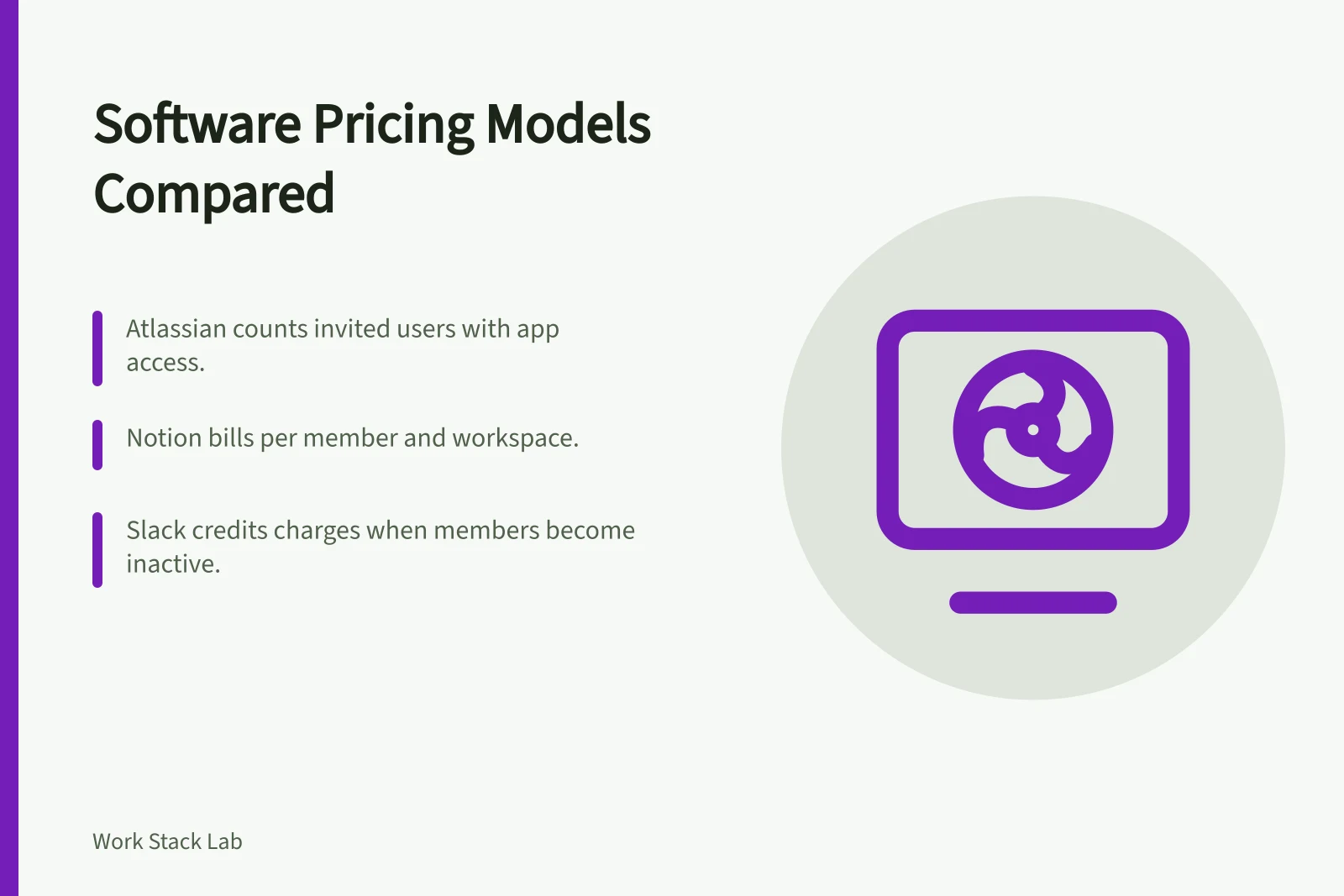
- The four tools do not share a chargeable unit. Atlassian counts users with app access, monday.com counts seats by product and plan, Notion counts members per workspace, and Slack counts active members under its Fair Billing Policy.
- Access, not activity, drives most charges, so an invited account that never signs in can still be billed.
- Slack is the only one of the four that applies inactivity credits in this comparison, and only inside its self-service policy.
- Notion and Slack prorate additions. Notion applies member reductions at the next billing cycle.
- Compare dated sterling quotes, because list rates shift with plan, territory, tax and commitment.
How the four records count a chargeable user
Charge unit
- Atlassian
- User with access to the app and its plan
- monday.com
- Seat, shaped by product, plan and payment term
- Notion
- Member seat in each workspace
- Slack
- Billable active member within policy scope
Activity rule
- Atlassian
- Access, not demonstrated use
- monday.com
- Not presented as an active-user credit model
- Notion
- Membership, not frequency of use
- Slack
- Supplier-defined activity status
Mid-period adjustment
- Atlassian
- Invited users can count on monthly subscriptions
- monday.com
- Minimum seat arrangements, with enterprise prices quoted
- Notion
- Additions prorated, reductions at the next cycle
- Slack
- Additions prorated, credits when members become inactive
Billing interval sits beside those four fields. A prepaid annual term and a cancellable monthly term produce different cash profiles even when the headcount is identical. Keep the interval in its own column so the two are never mixed.
Each record also carries a fifth field: the lever that changes the payable total. If you are still choosing which tools belong in the comparison, the five providers to shortlist sets out candidates to test against these units.
Five comparison fields
Field
- Charge unit
- What is billed
- Activity rule
- When it counts
- Billing interval
- Monthly or annual
- Mid-period adjustment
- Proration or credits
- Cost-control question
- What to verify
What it records
- Charge unit
- Activity rule
- Billing interval
- Mid-period adjustment
- Cost-control question
Where mid-period changes land
Atlassian's lever is access. If someone keeps app access, they keep costing money, whatever the login history shows. Removing access is the action that changes the count.
Notion's lever is membership inside each workspace. A mid-month removal still bills to the end of the cycle, so schedule removals before renewal when a team is shrinking.
Slack's lever is activity status. Inactive members attract credits inside the self-service policy, which suits teams whose usage dips between projects.
monday.com sets a floor through minimum seat arrangements, so the payable seat count can exceed the people who use the product.
Example: three headcount cases on one sheet
Illustrative only: the rate and headcount figures below are inputs the buyer supplies or takes from a dated quote, not published supplier prices.
- Record the chargeable unit each quote prices, so seats, members and active members stay in separate rows.
- Convert every candidate to monthly cash payable, with annual prepayment on its own line.
- Multiply the quoted monthly rate by three approved headcount figures: current access, expected peak and expected low point.
- Add setup fees, minimum commitments and metered excess as separate lines.
- Mark each line that depends on an unconfirmed guest rule or an inactivity credit.
- Recalculate the totals whenever the unit definition changes.
If the quoted rate is R pounds per chargeable identity per month, headcounts of 20, 30 and 15 give 20R, 30R and 15R. The arithmetic changes when the unit changes, which is the point of the sheet.
The software budget template with units and tax provides the columns for this exercise, including tax and timing.
Build the comparison sheet
- Put four records on one sheet
- Omit public headline amounts
- Record plan, quote, identities, tier
- Add adjustment rule and consumption
- Use monthly cash payable
- Run current, peak and low cases
Which model suits which buyer
- Access-based billing suits organisations that control app permissions tightly and can review them every month.
- Seat-and-tier billing suits teams that want bundled usage allowances, provided the minimum seat floor is understood.
- Per-member workspace billing suits teams with many light collaborators who can be guests, and it penalises sprawl across workspaces.
- Active-member billing suits seasonal or project-based teams, because inactivity credits reduce the bill.
- Contractors and short engagements fit best with prorated additions and a written removal rule.
Hybrid working keeps headcount moving, and the ONS employment and labour market statistics give a backdrop for setting peak and trough cases.
What to check before committing
- A dated sterling quote per candidate, showing the chargeable unit and VAT treatment.
- The exact mid-period rule for additions and removals, written into the order form.
- Minimum seat count, commitment months and any metered allowance.
- Guest and contractor classification, confirmed in writing before rollout.
- The tier that carries the control you need, checked against the feature list.
- A named owner and a monthly access review date.
VAT on most subscription charges sits at the 20% standard rate, and an adviser should confirm the supply and recovery position. See HMRC's VAT rates guidance.
Assess the vendor against NCSC cloud security guidance before signing.
The full cost of productivity software across five stages covers exit and switching costs that a monthly quote hides.
Common questions
Why does this comparison not list headline prices?
List rates shift with plan, territory, tax and promotions, so a like-for-like figure has to come from a dated quote. The comparison fixes the billing unit first, because the unit is what changes the total at a given headcount.
How does Slack's Fair Billing Policy change the bill?
It bills active members, prorates additions and credits charges when members become inactive, inside the scope of specified self-service purchases. Guest categories are treated separately, so confirm the classification in writing.
Which single number should a UK buyer compare?
Monthly cash payable, with setup fees and annual prepayment held on separate lines. That stops a prepaid annual term from being shown as a monthly equivalent beside a cancellable monthly plan.
What is the risk of relying on one model's wording?
A rule that credits inactive members on one service has no equivalent on an access-based service. Check the chargeable unit, not the plan name, before assuming two offers are comparable.