Costs and pricing
Part of Budgeting for productivity software means pricing the end at the beginning
Software return without turning time saved into fictional cash
Estimate software return without turning time saved into fictional cash: define the baseline, benefit route, ownership cost, uncertainty and review test.
Business productivity software return on investment is a model, not an observed fact. Its value depends on the baseline, the route from changed work to benefit and a complete cost boundary.
This method does not supply a benchmark or promise. It is intended for an England-based organisation using its own records. Finance should approve valuation, tax and accounting treatment, while operational owners must confirm whether proposed gains can occur.
What to take away
- Software return on investment is a model, not an observed fact, so its value depends on stated assumptions.
- Define the counterfactual before buying, since comparing a new tool with a frozen bad process overstates gains.
- Separate cashable saving, productive capacity, avoided cost and unmonetised value rather than calling all saved hours cash.
- Include the full investment cost across the chosen horizon, including exit, and show cash flow by period.
- Vary one input at a time to find the switching value where the option no longer meets the decision rule.
Define the counterfactual
Describe what happens without the purchase. Include continued use of present systems, any planned improvement and likely maintenance. Comparing a new tool with an artificially frozen bad process overstates the difference.
Choose measures before implementation. Examples include elapsed handling time, returned cases, missed handovers or support contacts. State population, observation period and exclusions. Seasonal workloads and staffing changes belong beside the baseline.
Trace each claimed benefit
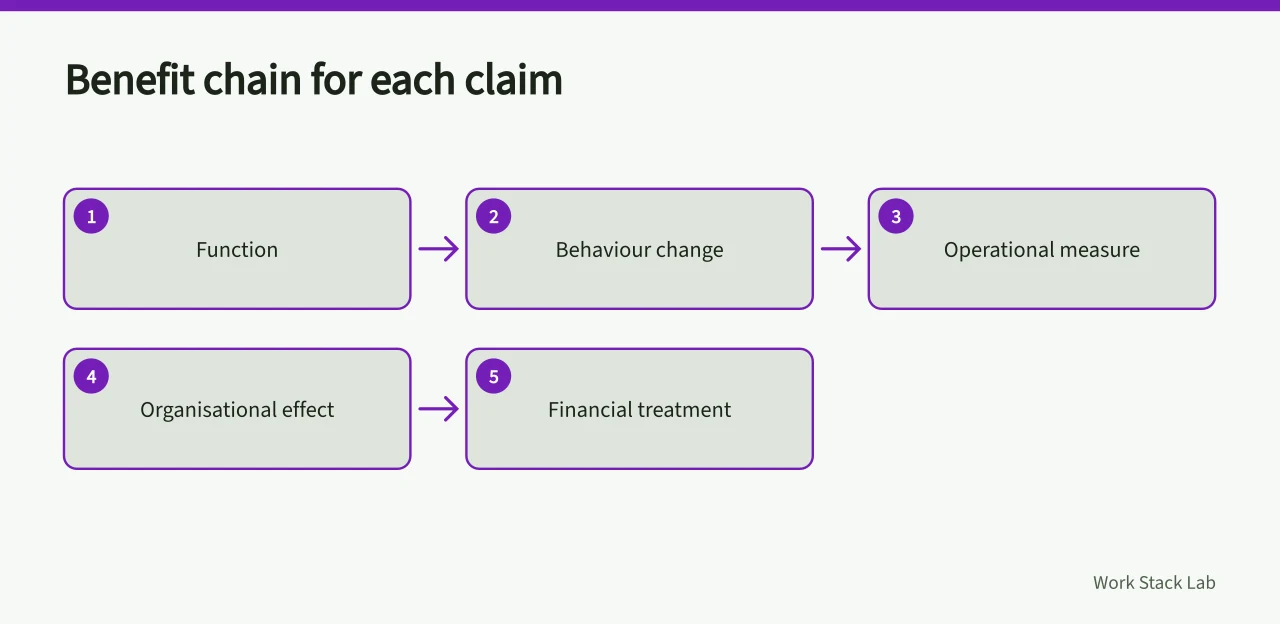
For every benefit, write a chain: function, behaviour change, operational measure, organisational effect and financial treatment. If automated routing removes five minutes from a task, the analysis still needs valid volume evidence and a plan for the released time.
Four outcome types
Outcome
- Cashable saving
- Spending genuinely falls
- Productive capacity
- Time can be redirected
- Avoided cost
- Credible future expense no longer arises
- Unmonetised value
- Reliability or user experience
What it means
- Cashable saving
- Productive capacity
- Avoided cost
- Unmonetised value
The government's Digital and Data Benefits framework sets out methods for public programmes, including identifying affected roles and tasks before valuing time. It is not a private-sector savings rate. Use its questions, not its central-government estimates.
Separate four outcomes:
- cashable saving, where spending genuinely falls;
- productive capacity, where time can be redirected;
- avoided cost, where a credible future expense no longer arises;
- unmonetised value, such as reliability or user experience.
Do not label all hours saved as cash. Use actual loaded role costs approved by finance and avoid counting the same time in two benefit categories.
Use the full investment cost
Include selection, implementation, internal change, subscription, administration, security, support, renewal and exit across the chosen horizon. Keep VAT cash flow and expected recovery distinct. HMRC says the standard rate is 20% for most supplies on its VAT rates page, but the applicable and recoverable amounts require case-specific review.
Full investment cost items
- Selection
- Implementation
- Internal change
- Subscription
- Administration
- Security
- Support
- Renewal and exit
A simple management ratio can divide net quantified benefit by the relevant investment cost. Define both numerator and denominator beside the result. Also show cash flow by period; a positive multi-year ratio can conceal an unaffordable first year.
Challenge the answer
Vary one important input at a time: adoption, task volume, time change, billable seats, implementation effort or renewal price. Find the switching value at which the option no longer meets the decision rule.
HM Treasury's Green Book 2026 asks public appraisals to address uncertainty, optimism bias and switching values, and warns against choosing solely by one summary metric. Private businesses do not have to apply its social appraisal rules, but that warning fits a software case.
Check for attribution before accepting a change as benefit. Staffing, demand, policy and another system may have shifted during the same period. Where a clean comparison is impossible, describe the competing explanations and lower the confidence rather than awarding the whole movement to software.
Guard against double counting as well. Faster completion and fewer staff hours may describe the same improvement. Reduced error handling can overlap with lower support volume. Build a short dependency map and choose one primary valuation route, leaving related measures as corroboration unless finance approves a distinct effect.
Verify after launch
Assign each measure an owner, source and collection date. Compare actual invoices, hours and service data with the original assumptions. Record adverse effects too, including rework or additional administration.
Set a decision date to continue, change or stop. A responsible conclusion might be that evidence is still insufficient. Preserving that uncertainty is better than publishing a precise return that the organisation never measured.
Before you act
- Describe what happens without the purchase.
- Choose measures before implementation and state exclusions.
- Write a benefit chain for every claimed benefit.
- Use actual loaded role costs approved by finance.
- Include selection, implementation, subscription, support and exit costs.
- Assign each measure an owner, source and collection date.
Common questions
Why is comparing a new tool with a frozen bad process a problem?
The article says comparing a new tool with an artificially frozen bad process overstates the difference. The counterfactual should describe what happens without the purchase, including continued use of present systems, any planned improvement and likely maintenance. That gives a fairer baseline against which the proposed change is judged.
How should saved time be treated in the analysis?
Do not label all hours saved as cash. Separate cashable saving, where spending genuinely falls, from productive capacity, where time can be redirected, and from avoided cost and unmonetised value. Use actual loaded role costs approved by finance and avoid counting the same time in two benefit categories.
What should happen after the software is launched?
Assign each measure an owner, source and collection date. Compare actual invoices, hours and service data with the original assumptions, and record adverse effects such as rework or additional administration. Set a decision date to continue, change or stop, and accept that evidence may still be insufficient.