Measurement
Part of Measure productivity software with a metric contract and a baseline you can revisit
Six productivity software measures, from qualifying demand to an outcome indicator
Define a compact set of productivity software measures for demand, delay, flow, quality, use and outcomes without inventing targets or causal claims.
The most useful business productivity software key metrics describe demand, delay, completion quality and outcomes. Start with six written definitions. Add a measure only when it changes a decision.
These examples are for an organisation in England and contain no universal targets. An analyst should validate the calculations. Privacy, employment and finance reviewers must approve person-level monitoring or monetary interpretation.
What to take away
- Define each productivity measure in writing before collecting data, and add a measure only when it changes a decision.
- Demand, delay, cycle time, first-pass acceptance, adoption and outcomes each answer a different question about a service.
- A falling cycle time may reflect smaller jobs, deleted difficult cases or lower demand rather than better performance.
- Never treat meaningful adoption as an individual productivity score without lawful, fair handling under worker-monitoring rules.
- Retire any measure that does not lead to a decision or investigation instead of filling the dashboard.
Qualifying demand
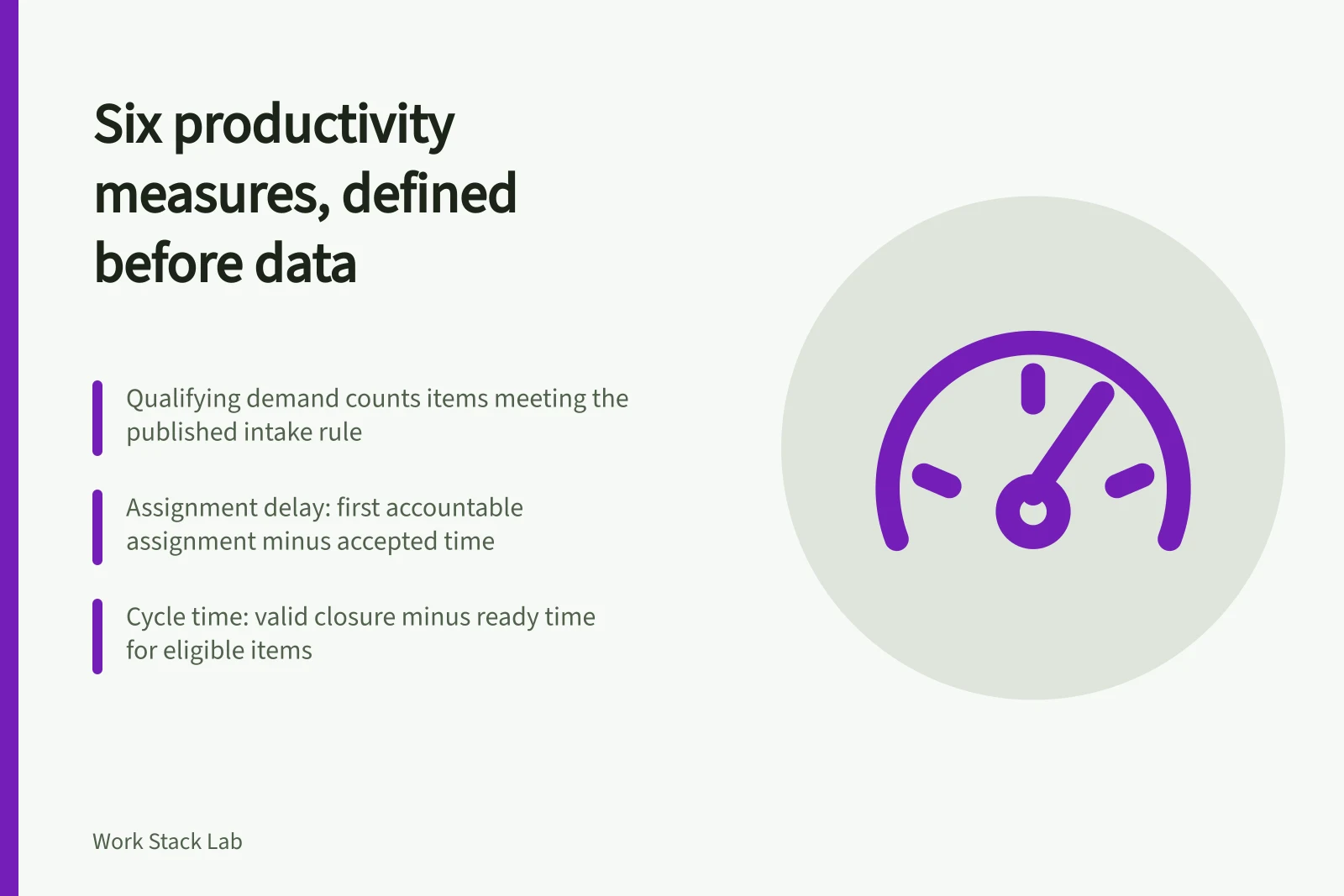
Definition: count items received during the reporting period that meet the published intake rule. Report rejected, duplicate and incomplete items separately rather than making them disappear.
Qualifying demand intake
- Items received during period
- Apply published intake rule
- Qualifying demand counted
- Rejected items reported separately
- Duplicate items reported separately
- Incomplete items reported separately
This shows workload entering the service. Segment by work type or route only if those fields are consistently recorded and the grouping is lawful. Rising demand can explain a longer queue; it does not establish poor staff performance.
Assignment delay
Definition: for accepted items, calculate first accountable assignment time minus accepted time. State calendar or staffed hours, then report a median and an ageing tail.
Assignment delay clock
- Accepted timeclock starts
- First accountable assignmentclock stops
- Reassignmentdo not reset clock
- Original eventkeep for audit
This isolates waiting before ownership. Do not reset the clock after reassignment. Keep the original event so a handover cannot make an old request look new.
Cycle time
Definition: calculate valid closure time minus ready time for eligible items closed in the period. Publish the states that pause the clock and separate materially different work classes.
Cycle time clock
- Ready timeclock starts
- Pause statesexcluded from clock
- Valid closure timeclock stops
- Work classesreported separately
Cycle time reflects elapsed flow, not hours of human effort. A decrease may come from smaller jobs, deleted difficult cases or lower demand. Pair it with volume and quality before drawing a conclusion.
First-pass acceptance
Definition: divide closures accepted without reopening inside the review window by all eligible closures in that cohort. Specify what counts as reopening and how long the window lasts.
This catches a speed measure that rewards premature closure. Sample the underlying cases because a low reopen rate might also mean users gave up or raised a new item instead.
Meaningful adoption
Definition: divide eligible intended users who performed the agreed workflow action during the period by all eligible intended users. Name the action. A login or page view may be too weak.
Never use this automatically as an individual productivity score. The ICO's worker-monitoring guidance covers software that records how workers spend time and requires lawful, fair handling. The page is under review after legislative change, so obtain current privacy and employment advice.
Outcome indicator
Definition: choose an observable user or business result, with population, unit and period. It might be successful task completion under a stated research protocol, fewer validated errors, or an approved cost measure.
GDS guidance on measuring service success combines performance indicators with user research and other sources. Its specific duties concern government services. The transferable point is that system activity cannot answer every outcome question.
Put each measure on a card
Record purpose, formula, fields, eligibility, exclusions, clock, period, source, owner, checker, version and known bias. The Government Data Quality Framework offers completeness, uniqueness, consistency, timeliness, validity and accuracy as useful quality dimensions. Apply them proportionately to the data journey.
Recalculate a small record sample by hand before relying on the automated result.
For the first report, show the value, denominator or record count, prior comparable period and a short limitation. If the source changed, do not draw a trend line across the break without an annotation. If the measure does not lead to a decision or investigation, retire it rather than filling the dashboard.
Before you act
- Write a definition for each measure before collecting data.
- Report rejected, duplicate and incomplete items separately from qualifying demand.
- State whether delay and cycle time use calendar or staffed hours.
- Specify what counts as reopening and how long the window lasts.
- Record purpose, formula, fields, owner, checker and known bias on a card.
- Recalculate a small record sample by hand before trusting the automated result.
Common questions
Why should demand be reported separately from rejected or duplicate items?
Qualifying demand counts only items meeting the published intake rule. Rejected, duplicate and incomplete items should be reported separately rather than made to disappear. This shows the workload actually entering the service, and rising demand can explain a longer queue without establishing poor staff performance.
What does cycle time actually measure?
Cycle time is valid closure time minus ready time for eligible items closed in the period. It reflects elapsed flow, not hours of human effort. A decrease may come from smaller jobs, deleted difficult cases or lower demand, so pair it with volume and quality before drawing a conclusion.
How should meaningful adoption be handled for individuals?
Meaningful adoption divides eligible intended users who performed the agreed workflow action by all eligible intended users, and the action must be named. Never use it automatically as an individual productivity score. The ICO worker-monitoring guidance covers software recording how workers spend time and requires lawful, fair handling.