Foundations
Part of Assessing England's productivity software market by the job, not the category
Six signs of real demand for a productivity software idea, and how to read them
Use six observable demand signals to test an England productivity software idea, while keeping UK surveys, regulation and customer behaviour in context.
Demand is more convincing when a business is already spending time, money or management attention on a problem. A general statement that firms want to be more productive is too weak to support a product decision.
This list was researched on 5 September 2026. Signals were included when an official UK source described a relevant obligation, adoption behaviour or business population, and when a supplier could test the implication directly with English customers. It excludes vendor surveys, search-volume estimates and product rankings. The six signals are a sequence to run per segment, not a ranking.
What to take away
- A compulsory digital workflow with a clear date creates a bounded signal for record-keeping and connected finance workflows.
- Buyers who request integration before features reveal data maturity, ownership and existing systems.
- The strongest early signal is an agreed action with cost or scarce staff time.
1. A compulsory digital workflow has a clear date
HMRC's Making Tax Digital for Income Tax collection says eligible sole traders and landlords with qualifying income above £50,000 entered the regime from 6 April 2026. They must use compatible software for digital records and specified submissions.
MTD Income Tax Timeline
- 6 April 2026£50,000+ sole traders and landlords enter regime
- OngoingMust use compatible software for digital records
- OngoingMust use compatible software for specified submissions
That creates a bounded signal for record-keeping and connected finance workflows. It does not create demand for every productivity application. Verify that the proposed tool serves an affected task, and never imply that an adjacent feature is HMRC-approved unless the official record says so.
2. Staff maintain the same manual workaround
A repeated spreadsheet export, copied status update or re-keyed customer record is observable evidence of friction. Count the people and hand-offs, but do not turn their recalled time into a national savings claim.
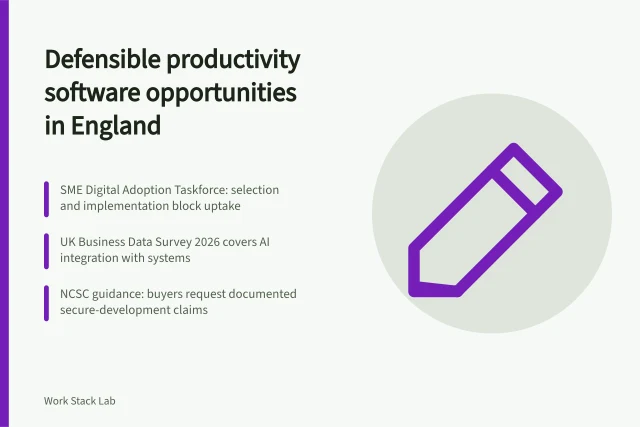
The SME Digital Adoption Taskforce report treats cloud, customer management and resource-planning software as potentially productivity-enhancing. Its UK policy scope supports investigating adoption barriers, not assuming that every SME has the same problem.
Can a participant show the last completed cycle, including exceptions and corrections?
3. Buyers request integration before features
The UK Business Data Survey 2026 found that integration of AI tools with business systems varied by business size within its surveyed population of organisations handling digitised data. This is a clue to ask about data maturity, ownership and existing systems.
Does the buyer name the source system, the required fields and the accountable administrator?
4. A renewal or contract event creates a decision window
Customers often tolerate awkward software until a licence renewal, outsourcing change, office move or client requirement forces review. Ask for the decision date, notice period and people who must approve replacement. A dated procurement window is stronger than an undated expression of interest.
For cloud services, the National Cyber Security Centre's SaaS security guidance prompts customers to consider onboarding, permissions, data, incidents and leaving the service. Those questions can reveal whether the organisation is genuinely preparing to change.
5. Managers will provide data for a scoped trial
Offering a representative, appropriately protected sample requires more commitment than joining a mailing list. The trial should specify purpose, success measure, access and deletion. If personal information is involved, the ICO says data protection should be considered from design through the lifecycle.
Refusal is not automatically lack of demand; security or confidentiality may be the barrier. Record the reason and design a safer test rather than asking for unnecessary data.
6. The budget owner accepts a next commitment
The strongest early signal is an agreed action with cost or scarce staff time: paid discovery, security review, implementation planning or a pilot approved by the budget holder. Write down what was authorised and what remains conditional.
Score these six signals separately for each segment. Three interviews from one sector cannot establish demand across England, but a pattern of demonstrated workarounds, dated decisions and real commitments can justify the next controlled experiment.
For a worked example, take one segment: independent veterinary practices in a single English county. Score each interview 0 for no evidence, 1 for a stated problem and 2 for demonstrated work.
A practice that shares a repeated stock-order export scores 2 on signal two. A dated insurance renewal scores 2 on signal four. A practice manager who approves software spend and is named in the interview scores 2 on signal six.
Two interviews of that shape out of five would justify a scoped trial for that segment, not a claim about the wider market.
Before you act
- Verify the proposed tool serves an affected task.
- Ask a participant to show the last completed cycle.
- Ask for the decision date and notice period.
- Specify purpose, success measure, access and deletion for a trial.
- Record the reason for refusal and design a safer test.
- Score the six signals separately for each segment.
Common questions
What makes a demand signal convincing?
A general statement that firms want to be more productive is too weak to support a product decision, so the article treats demonstrated workarounds and dated decisions as stronger evidence.
How should a reader treat the Making Tax Digital signal?
It creates a bounded signal for record-keeping and connected finance workflows, but it does not create demand for every productivity application. Verify that the proposed tool serves an affected task, and never imply that an adjacent feature is HMRC-approved unless the official record says so.
What should a reader do if a manager refuses a trial?
Refusal is not automatically lack of demand; security or confidentiality may be the barrier. Record the reason and design a safer test rather than asking for unnecessary data. The trial should specify purpose, success measure, access and deletion, and data protection should be considered from design through the lifecycle.