Costs and pricing
Part of Budgeting for productivity software means pricing the end at the beginning
Paid identities, seat bands and other productivity software costs that get missed
Seven commonly missed software cost areas, each tied to an authoritative billing, tax, security, consultation or exit record for England-based buyers.
Business productivity software hidden costs are usually visible somewhere, but not in the headline rate. This non-ranked list includes seven areas supported by current first-party or UK authoritative records checked on 5 September 2026. It is scoped to budgeting by organisations in England.
Inclusion required a cost driver outside a basic displayed subscription and a source explaining the relevant rule or responsibility. We did not obtain quotes, open accounts or test products. Finance, tax, employment, security and commercial specialists must assess the real purchase.
What to take away
- Hidden productivity software costs sit outside the headline rate and need separate budget lines.
- Seat bands, paid identities and metered allowances can make the charged quantity differ from headcount.
- Consultation, security, data and exit work all consume staff time and specialist input.
- Mark each cost category as applicable, not applicable with a reason, or unresolved.
- Recheck membership, tiers and supplier terms at quotation, contract review and renewal.
- No supplier influenced this list and no supplier amount is quoted, because published rates depend on contract size and change; each section gives a worked example of the quantity to test.
1. Paid identity definitions
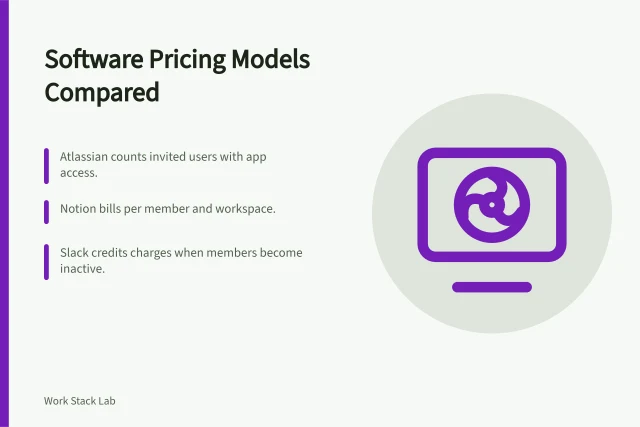
A collaborator may become billable because of status, not actual use. Notion says paid workspaces are charged per member, with specific timing for additions and removals. Slack charges per active user, Zoom per licensed host and Figma per editor seat.
Model employees, contractors and guests according to the proposed terms, then give someone ownership of membership reviews. Worked example: a 50-person organisation with 12 contractors and 8 guests models up to 70 paid identities, and the gap from headcount is the first amount to test.
Is a collaborator billable?
Is the person a workspace member?
charged per member
not billable
2. Seat bands and consumption allowances
The exact headcount may not be the charged quantity. The monday.com pricing record describes plan and user factors, minimum seats, and allowances for some automation, integration or AI functions. Atlassian prices Jira and Confluence per user, and Microsoft 365 and Google Workspace bill per user per month on annual or monthly terms.
Put seat steps and metered triggers in the sensitivity sheet rather than treating today's usage as fixed. Worked example: where an entry plan sets a three-seat minimum, one active user is still billed for three seats, or three times headcount.
3. VAT and cross-border administration
HMRC publishes a 20% standard VAT rate for most goods and services. The supply, supplier location, invoice and buyer's recovery position can require more work than applying that percentage.
Worked example: a £12,000 annual subscription is £14,400 gross if the full amount is standard-rated and the buyer cannot recover input tax. The same supply costs a fully taxable buyer £12,000 net after recovery. Keep gross cash, net cost and any recoverable amount separate until a tax adviser confirms them.
4. Consultation and training time
A workflow change draws staff away from other tasks for discovery, consultation, practice and support. Acas explains that consultation involves talking and listening about organisational changes, while legal requirements vary by situation.
Worked example: twenty employees at four hours each is 80 hours of staff time, and the cash figure depends on the pay rates you apply. Budget participant and manager time, and seek employment advice where the software affects monitoring or contractual practice.
5. Customer-side security operations
Buying SaaS does not remove access reviews, protected administration, incident preparation or monitoring. The NCSC's SaaS guidance sets out these continuing customer activities.
Worked example: quarterly access reviews across 200 accounts at ten minutes each is about 33 hours per review, or roughly 133 hours a year, before any incident work. Price the roles and any additional logging or identity services needed for the intended risk.
6. Data and contract work
Personal-data use can create assessment, negotiation and ongoing review tasks. The ICO's processor-contract guidance covers required processing details, sub-processors, security, assistance, audits and end-of-contract handling. It is under review after recent legislation, so qualified review and a current check are essential.
Worked example: ten processor contracts at two hours each is 20 hours before any re-review.
7. Migration and exit
Exports, transformation, archive storage, parallel running, replacement setup and specialist help can all arise at departure. Government technical lock-in guidance asks public buyers to consider open formats, migration expense and skills dependency.
Worked example: one month of parallel running means paying for the old and new service in the same month, so the exit line starts at one extra subscription month plus migration time. Private buyers can use those categories without claiming the policy binds them.
Running the budget check
Add these seven headings to the budget before comparing totals. A small team using public information may not need the same assurance work as a regulated service holding employee records, while its seat-band exposure could be greater. This triage keeps the list proportionate without deleting awkward unknowns.
- List each of the seven cost headings in the budget.
- Name the unit, evidence, date, owner and uncertainty for each.
- Request evidence only for material exposures.
- Keep gross cash, net cost and recoverable VAT separate.
Where no defensible amount exists, mark it unresolved and set the action needed to obtain one.
Run the check again at quotation, contract review and renewal. Membership, feature tiers, integrations and supplier terms can change after the first estimate, so the original research date must remain attached.
Common questions
Why can a collaborator become billable without actually using the software?
Notion says paid workspaces are charged per member, with specific timing for additions and removals. Status rather than actual use can therefore trigger a charge. Model employees, contractors and guests against the proposed terms, then give someone ownership of membership reviews so removals happen on time.
Why might the exact headcount not match the amount charged?
The monday.com pricing record describes plan and user factors, minimum seats, and allowances for some automation, integration or AI functions. Seat steps and metered triggers can push the charged quantity away from headcount. Put those steps and triggers in the sensitivity sheet rather than treating today's usage as fixed.
What should a buyer do when no defensible amount exists for a category?
Mark it unresolved and set the action needed to obtain an amount. A category with no defensible amount still belongs in the budget, because removing it hides the exposure.