Reviews
Part of How to compare eight productivity software tools before reaching a verdict
Reading a productivity software agency record, with HSO as a worked dossier
Assess productivity software agencies through identity, scope, delivery and evidence checks, illustrated with a disclosed UK desk-research dossier.
Business productivity software agency reviews should identify a contracting party and delivery proposition before discussing reputation. A platform badge, testimonial or directory position cannot show that the proposed team will handle a particular implementation well. HSO is used here as a single illustrative dossier, not as a ranked or recommended agency.
Reviewer: Codex editorial research desk. Research date: 5 September 2026. This page uses desk evidence only. No agency was contacted, shortlisted in a live procurement, commissioned or tested. No client reference was approached and no implementation artefact was inspected. There was no payment, free service, affiliate arrangement or provider input, and no known conflict.
What to take away
- A platform badge or testimonial cannot show that a proposed team will handle a particular implementation well.
- The HSO dossier locates identity and public service description, but delivery evidence remains outstanding.
A method for reading an agency record
Start with five separate questions:
A worked example is HSO Enterprise Solutions Limited, company number 09910591, which has a Companies House record and a G-Cloud listing.
Five questions for an agency record
- Which legal entity signs and invoices?
- Which platform and services are in scope?
- Who delivers, what is subcontracted?
- How will discovery, testing, handover work?
- Which claims come from which source?
- Which legal entity would sign and invoice?
- Which platform and services are actually in scope?
- Who would deliver, and what might be subcontracted?
- How will discovery, configuration, testing, acceptance and handover work?
- Which claims come from the agency, a platform, a public register or a named customer?
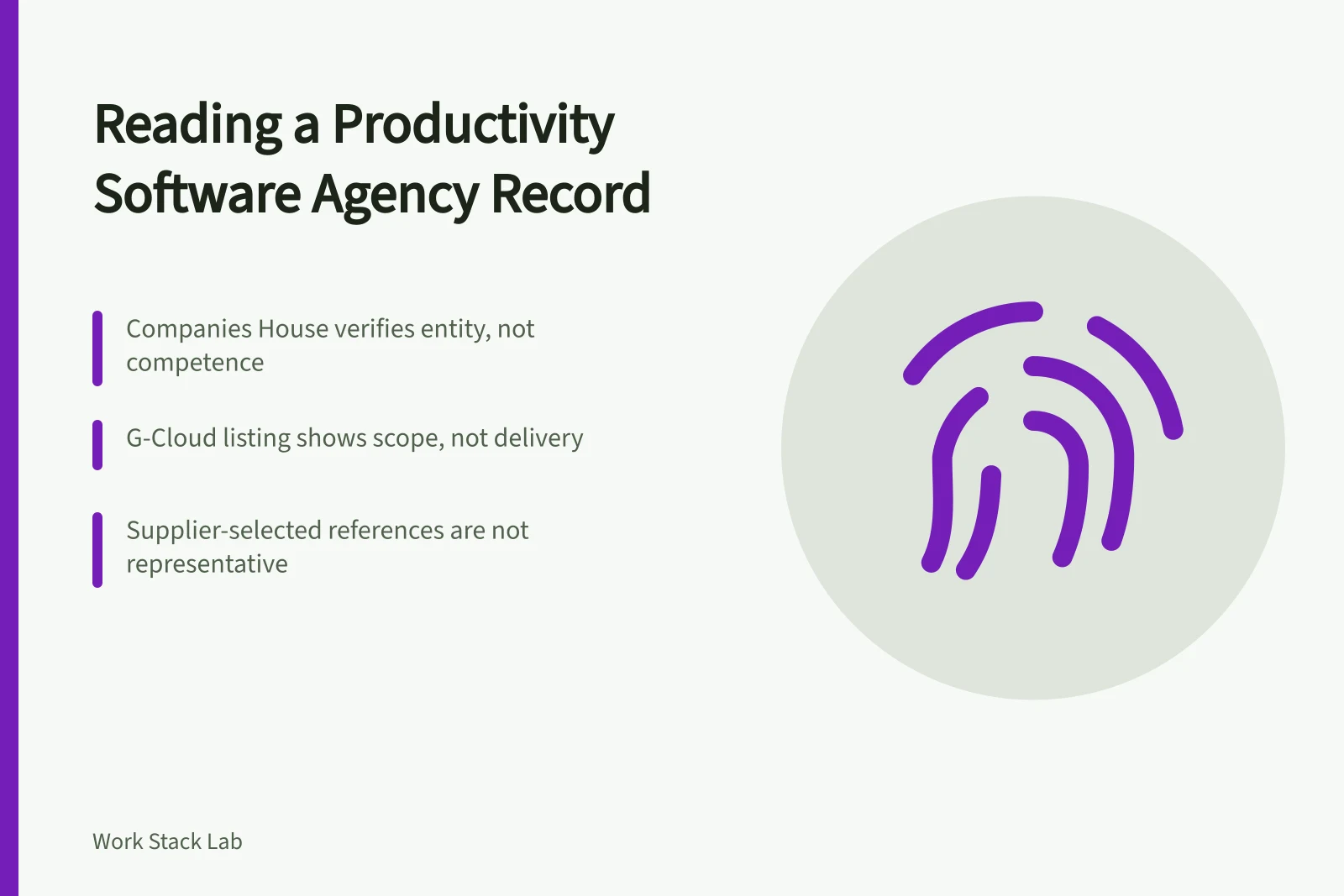
Require evidence at the right level. A Companies House record can establish incorporation details and filing status, but not competence. A government marketplace entry records a service proposition and supplier statements; it does not guarantee suitability. The agency's own material can define its offer, although outcome claims remain first-party claims.
Worked desk dossier: HSO Enterprise Solutions Limited
The current Companies House overview identifies that company as an active English private company with information technology consultancy as a stated activity. This verifies the named entity at the research date.
What each HSO record can prove
Companies House
- Source type
- Public register
- Establishes
- Entity and filing status
- Cannot establish
- Competence
G-Cloud listing
- Source type
- Public marketplace
- Establishes
- Service proposition
- Cannot establish
- Suitability
HSO capabilities page
- Source type
- First-party marketing
- Establishes
- Stated offer
- Cannot establish
- Outcome claims
A live G-Cloud service listing names that company and describes Microsoft 365 consultancy and implementation, support routes, data export information and several supplier-declared standards.
HSO's own capabilities page says its services span planning, implementation and operation around Microsoft cloud products. The first two records are independently hosted public records; the service description contains supplier representations. The third is first-party marketing.
This evidence is enough to identify a provider for further questions. It does not justify a rating, recommendation or claim about delivery. We did not verify personnel, certificates, customer outcomes, pricing, contractual terms or whether the published service matches a private buyer's proposed scope.
Before you act
- Ask for the named delivery lead, allocated roles and substitution rules.
- Set one work samplediscovery plan, migration rehearsal, acceptance criteria and exit pack.
- Request references with permission, covering comparable starting conditions.
Questions the dossier leaves open
Ask the bidder to name the delivery lead and people allocated to discovery, architecture, migration, training and support. Request their role-specific experience, availability and substitution rules. Clarify group-company involvement and insist that the proposal names the legal entity responsible for each obligation.
Give every agency the same small work sample. A good response might be a discovery plan that names the workshops, data sources, migration batches, permissions model, test cases and rollback steps. It should also set acceptance criteria: for one workflow, who signs off, what evidence is required and what happens if a test fails.
References should cover comparable starting conditions and be used with permission. Ask about scope changes, defect handling, staffing continuity, knowledge transfer and the state of the service after handover. Supplier-selected references are not a representative customer sample.
CMA's review and endorsement guidance is relevant if you publish review material.
For a buyer, the desk dossier's safer conclusion is "identity and public service description located; delivery evidence outstanding". Procurement, legal, privacy and security reviewers should decide the next step: structured clarification or exclusion.
Common questions
What can a Companies House record establish about an agency?
It can establish incorporation details and filing status. The method section sets out how to weigh that record against other evidence.
What does the HSO dossier actually prove?
It proves that HSO Enterprise Solutions Limited is an active English private company with company number 09910591. It also locates a live G-Cloud service listing and HSO's own capabilities page. The article says this evidence is enough to identify a provider for further questions, but does not justify a rating or recommendation.
What should a buyer ask a bidder to name?
A buyer should ask the bidder to name the delivery lead and people allocated to discovery, architecture, migration, training and support. The article also says to request their role-specific experience, availability and substitution rules, and to clarify group-company involvement and the legal entity responsible for each obligation.