Outlook
Part of Reading productivity software signals with a label on each, from products to economic data
Four AI capability bundles for English workplaces, with a September 2027 planning horizon
An England-specific AI skills scenario with four capability bundles, labour-market boundaries, role examples and a checklist for planning learning by September 2027.
A skills forecast should guide recruitment and learning decisions without pretending to know next year's job titles. For organisations in England, a practical horizon is September 2027: long enough to prepare people for AI-enabled workflows, but short enough to revise the plan when products or guidance change.
The forecast below is an editorial scenario prepared on 5 September 2026. It is not a prediction of vacancies, pay or headcount.
What to take away
- Plan skills around four bundlesworkflow framing, evidence and evaluation, control literacy and service ownership.
- A benchmark describes what people may need, not what a workforce already has.
- The AI Labour Market Survey 2025 is diagnostic, not a census of the English workforce.
- Course completion is an input, not proof that someone can do the work.
- The scenario becomes more urgent when software can update records or communicate externally.
Start from an England-specific baseline
Skills England published its AI foundation skills benchmark in January 2026. It applies to England and covers basic technical, non-technical, responsible and ethical capabilities for using simple AI tools at work. A benchmark describes what people may need; it does not show that a workforce already has those capabilities.
The later employer guide to AI upskilling recommends programmes that are practical, reachable, integrated, modular, expandable and sustainable. Its adoption-stage figures come from the guide's research and should not be treated as a census of every English employer.
Plan four capability bundles
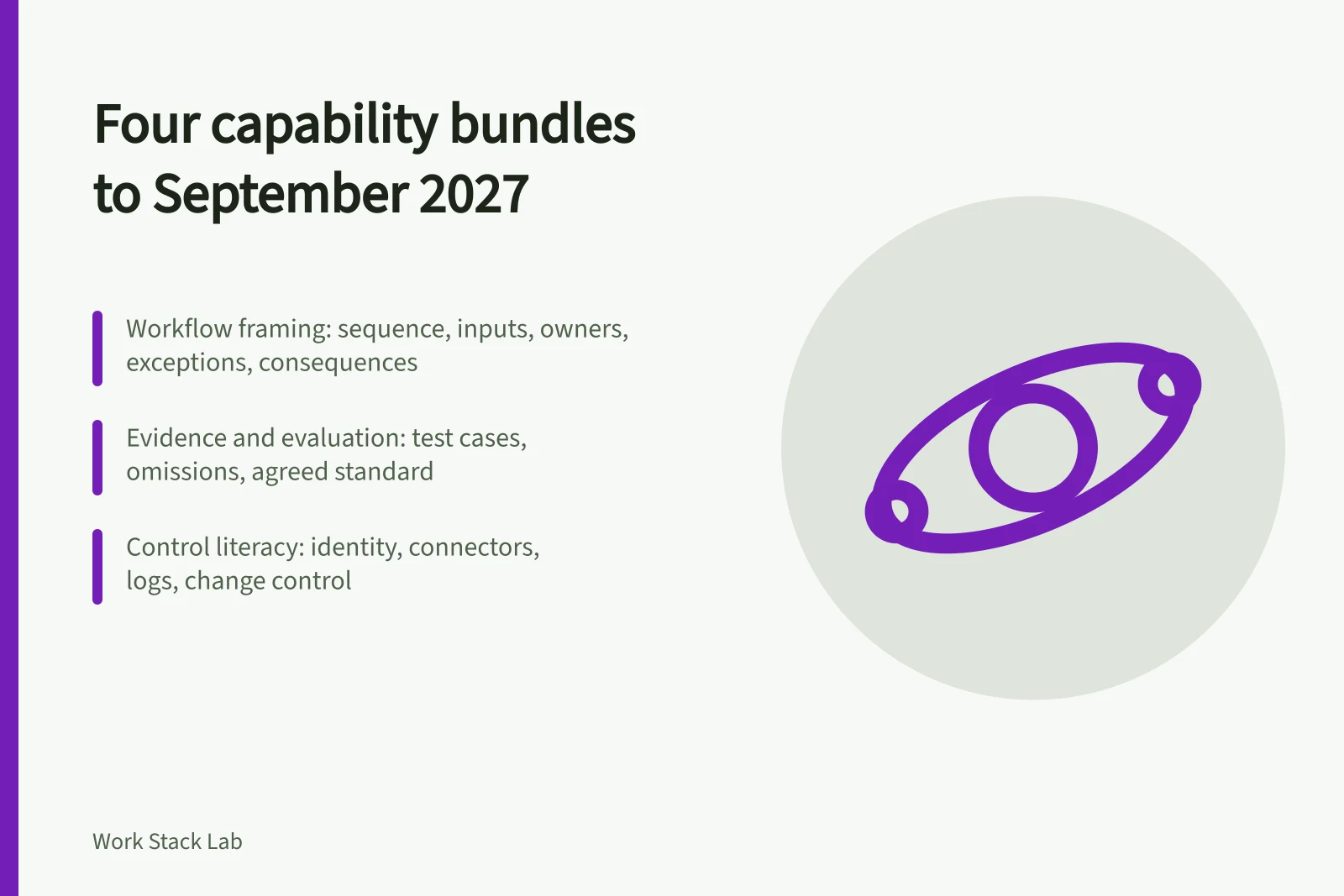
Workflow framing comes first. Staff must describe the real sequence, inputs, owners, exceptions and consequences before configuring an application. A tool expert who cannot recognise a dangerous exception may automate the wrong process efficiently.
Four capability bundles
- Workflow framingsequence, inputs, owners, exceptions
- Evidence and evaluationsources, test cases, omissions
- Control literacyclassification, permissions, approval, audit
- Service ownershipchanges, exceptions, supplier, retirement
Evidence and evaluation skills follow. Users need to distinguish a source from generated prose, design representative test cases, notice omissions and compare output with an agreed standard. For measured work, they should understand the metric denominator and avoid attributing every change to software.
Control literacy covers data classification, permissions, human approval, audit records, incident escalation and recovery. These responsibilities should be divided across users, administrators, information governance and security rather than left with whoever first tried the feature.
Service ownership joins the pieces. Someone must approve material configuration changes, monitor exceptions, manage the supplier relationship and decide when to pause or retire the workflow. This is operational accountability, not necessarily a new occupation.
Use labour research with its proper boundary
The Department for Science, Innovation and Technology's AI Labour Market Survey 2025 reports widespread skill gaps among respondent AI-sector organisations and frequent use of on-the-job training. It also records respondents' plans for agentic AI over the following three years. The study does not represent the whole English workforce, and an employer's plan is not a delivered deployment.
Its value is diagnostic. If a proposed workflow depends on specialist evaluation, security engineering or data expertise, verify that the capability exists instead of assuming a general course will cover it.
A role-based scenario to September 2027
Front-line users need less on prompt tricks, more on checking, exception handling and safe escalation. Team leaders must set approval thresholds, sample outputs for quality and interpret operational measures.
Role-based skill priorities
Front-line users
- Focus
- Checking, exceptions, escalation
- Less need
- Prompt tricks
- Key output
- Safe escalation
Team leaders
- Focus
- Approval thresholds, sampling
- Less need
- Prompt tricks
- Key output
- Quality interpretation
Administrators
- Focus
- Identity, connectors, logs
- Less need
- Prompt tricks
- Key output
- Change control
Procurement and governance
- Focus
- Supplier evidence, data terms
- Less need
- Prompt tricks
- Key output
- Exit arrangements
Administrators need working knowledge of identity, connectors, logs and change control. Procurement and governance staff should compare supplier evidence, data terms, support and exit arrangements.
This scenario becomes less relevant if agents remain outside core workflows. It becomes more urgent when software can update records or communicate externally. Review it after a material product release, a regulator update, an incident or a change in data use.
Turn the forecast into a learning plan
Choose one live workflow and define what competent performance looks like for each role. Use a safe practice environment with normal cases, edge cases and failures. Check whether people identify uncertainty, preserve evidence and escalate at the right point. Repeat the assessment after configuration changes.
Turn forecast into learning plan
- Choose one live workflow
- Define competent performance per role
- Use safe practice environment
- Check uncertainty and escalation
- Repeat after configuration changes
Course completion is an input, not proof of ability. Better measures include correct exception handling, inappropriate-action detection, recovery time and the quality of decision records. Employment, monitoring and role-change implications require qualified review before publication or implementation.
The central planning question is simple: what must each person be able to notice, decide and recover? That question will remain useful even if the product names and interfaces are different by September 2027.
Before you act
- Choose one live workflow and define competent performance per role.
- Use a safe practice environment with normal cases and failures.
- Check that people identify uncertainty and escalate at the right point.
- Divide control responsibilities across users, administrators, governance and security.
- Verify specialist evaluation, security and data capability before relying on general training.
- Repeat the assessment after configuration changes.
Common questions
Why is September 2027 a practical planning horizon?
It is long enough to prepare people for AI-enabled workflows, but short enough to revise the plan when products or guidance change. The forecast is an editorial scenario prepared on 5 September 2026, not a prediction of vacancies, pay or headcount.
What do the four capability bundles cover?
Workflow framing covers the real sequence, inputs, owners, exceptions and consequences. Evidence and evaluation covers sources, test cases and metrics. Control literacy covers classification, permissions, approval, audit, escalation and recovery. Service ownership covers configuration changes, exceptions, suppliers and retiring workflows.
How should an organisation measure whether the learning plan worked?
Course completion is an input, not proof of ability. Better measures include correct exception handling, inappropriate-action detection, recovery time and the quality of decision records. Check whether people identify uncertainty, preserve evidence and escalate at the right point, then repeat the assessment after configuration changes.