Outlook
Part of Reading productivity software signals with a label on each, from products to economic data
Five productivity software trends to monitor through September 2027
Five evidence-led productivity software trends to monitor through September 2027, with UK sources, limitations and practical review triggers.
These five business productivity software 2027 trends are signals to monitor, not a ranking or prediction. The review was completed on 5 September 2026 for organisations operating in England. Inclusion required a current official, regulator or first-party record and a plausible decision consequence before September 2027. Revenue forecasts, popularity tables and unsupported supplier outcome claims were excluded.
No product account or workflow was tested. There was no supplier payment, affiliate relationship or other known commercial conflict. Named features are described from provider records and need verification for the buyer's plan, region and configuration.
What to take away
- Treat the five 2027 trends as signals to monitor, not a ranking or prediction.
- Record how many workflows rely on AI and how often people override them.
- Test permissions, approval, logging and reversal when an agent can change work records.
- The business stays responsible when an agent handles customer queries, recommendations or refunds.
- Train staff on the actual workflow, including exceptions, data handling and escalation.
1. AI use is widening, but depth still matters
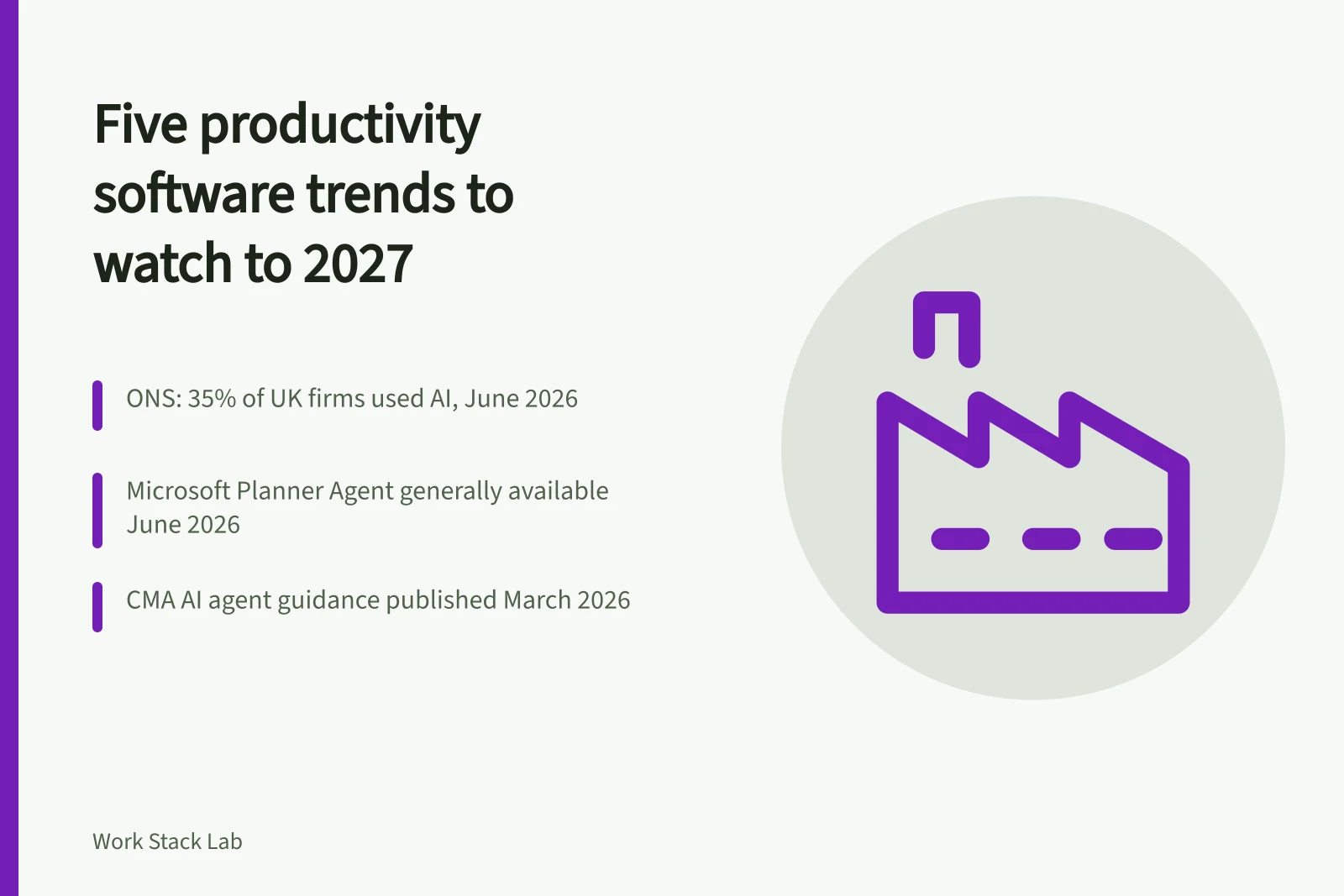
The Office for National Statistics found that around 35% of UK businesses with 10 or more employees used at least one specified AI technology in June 2026. Its AI analysis also distinguishes types and purposes of use. This is an observed UK statistic, not an England-only measure or evidence that most processes are automated.
For a 2027 review, record how many workflows rely on AI, which actions they perform and how often people override them. A rising adoption percentage alone should not justify a purchase.
2. Agents are moving from answers to work records
Microsoft stated in June 2026 that Planner Agent was generally available to Microsoft 365 Copilot customers, including task creation and updating. Asana presents AI Studio as a builder for workflows that classify, route, check and report on work. These are separate first-party descriptions, not comparative test results.
The review trigger is a proposed action that can change an owner, date, status or external message. At that point, test permissions, approval, logging and reversal rather than judging only the quality of generated text.
3. Customer-facing agents face ordinary consumer rules
The Competition and Markets Authority published AI agent guidance in March 2026. It says the business remains responsible when an agent handles customer queries, recommendations or refunds, including where a third party provides the technology.
This is a present UK compliance consideration, not a future trend claim. Before 2027, owners should identify any automated customer touchpoint and arrange specialist legal review of disclosures, testing, monitoring, oversight and redress.
4. AI guidance has dated update points
On the research date, the Information Commissioner's Office guidance timetable listed an agentic AI consultation for September 2026, final agentic guidance for spring 2027 and final automated decision-making guidance for winter 2026. Those are announced timings and could move.
Put the relevant publication pages in the project risk log. When a consultation or final text appears, check whether the data map, human intervention, explanation or supplier questions need revision.
5. Skills planning is becoming workflow-specific
Skills England's January 2026 AI foundation skills benchmark applies to England and covers technical, non-technical, responsible and ethical capabilities. Its later employer upskilling guide argues for practical, integrated and sustainable learning.
Neither document forecasts a guaranteed occupation mix in 2027. They support a more grounded action: train staff on the actual workflow, including exceptions, data handling and escalation, then check performance in the role rather than counting course completions.
What to do next
Assign each signal an owner, a source-check date and a decision it can change. A quarterly review is enough for most portfolios; bring it forward after a material supplier release, regulator publication or incident. Preserve the dated evidence, since a trend claim without its original scope can become misleading very quickly.
Before you act
- Assign each signal an owner and a source-check date.
- Verify named features for your plan, region and configuration.
- Identify any automated customer touchpoint and arrange specialist legal review.
- Add relevant ICO publication pages to the project risk log.
- Check whether your data map or supplier questions need revision.
- Preserve the dated evidence behind each trend claim.
Common questions
What did the Office for National Statistics find about AI use in UK businesses?
The ONS found that around 35% of UK businesses with 10 or more employees used at least one specified AI technology in June 2026. Its analysis also distinguishes types and purposes of use. This is an observed UK statistic, not an England-only measure or evidence that most processes are automated.
What should a buyer test once an agent can change an owner, date, status or external message?
At that point the review trigger is a proposed action that can change an owner, date, status or external message. Buyers should test permissions, approval, logging and reversal rather than judging only the quality of generated text. These are separate first-party descriptions, not comparative test results.
What announced ICO guidance timings should go into the project risk log?
On the research date, the ICO guidance timetable listed an agentic AI consultation for September 2026, final agentic guidance for spring 2027 and final automated decision-making guidance for winter 2026. Those are announced timings and could move. When a consultation or final text appears, check whether the data map, human intervention, explanation or supplier questions need revision.