Strategy
A productivity software strategy that measures the current route before proposing a better one
Create a practical productivity software strategy for an English business, with evidence gates, channel choices, risk controls and a usable roadmap.
A business productivity software strategy chooses whose work to improve, which constraint to remove and what evidence justifies further investment. You should be able to stop, narrow or change course without treating early assumptions as facts.
This guide is for teams planning a product or service for organisations in England. Some evidence is UK-wide and several methods come from the Government Service Manual.
Those sources are useful disciplines, but they do not prove a commercial proposition will work. No customer discovery, channel experiment or product test was run for this article. Sources were checked on 5 September 2026.
What to take away
- Start with one awkward piece of work, not a software category or broad ambition.
- Set a baseline from completed cases, keeping elapsed time separate from staff effort.
- Make strategic choices explicit about which roles come first and what the offer includes.
- A useful roadmap shows decisions, evidence and dependencies rather than a calendar full of features.
Start with one work problem
Begin with an awkward piece of work, not a software category. Describe who starts it, which record moves, where it waits, who can approve it and what makes completion visible. A broad ambition such as helping small firms work smarter leaves too many product and commercial questions unanswered.
The Government Digital Service describes discovery as a phase for understanding the problem, users, context and constraints before committing to a solution. Its guidance is written for public services, yet the underlying warning is equally relevant here: starting with a predefined answer can hide the real cause of the delay.
Problem boundary in four lines
- Business setting and role doing the work
- Event that starts and result that ends
- Present cost, risk or delay to investigate
- Cases deliberately left outside first decision
Write a problem boundary in four lines:
- the English business setting and the role doing the work;
- the event that starts the workflow and the result that ends it;
- the present cost, risk or delay to investigate;
- the cases deliberately left outside the first decision.
The boundary should exclude more than it includes. If the proposed software touches field work, for example, decide whether intermittent connectivity, personal devices and several premises belong in the first version. An exclusion is not permanent. It prevents an early plan from promising incompatible operating conditions.
Establish a baseline from completed cases
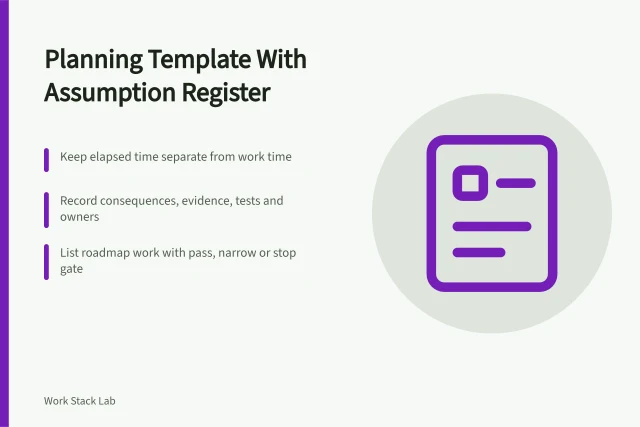
A credible objective needs a baseline. Follow recent, completed cases through the existing workflow. Record elapsed time separately from staff effort, because a job can wait for three days while requiring only twenty minutes of work. Count re-entry, hand-offs, corrections and unresolved exceptions. Note whether the evidence comes from system logs, documents, observation or recollection.
For a worked example, take five recent invoice approvals. Median elapsed time was three working days from receipt to approval. Staff effort was 42 minutes in total: 15 minutes checking, 10 minutes coding, 12 minutes chasing and 5 minutes filing. Two cases waited for a director who was on leave. The sample is illustrative, not a benchmark.
Do not generalise a handful of cases into England-wide productivity. Official business statistics can define a potential audience, not workflow performance. The Office for National Statistics publishes business activity, size and location tables for VAT or PAYE registered enterprises and local units. That is a segmentation frame with a stated registration boundary, not a count of likely software buyers.
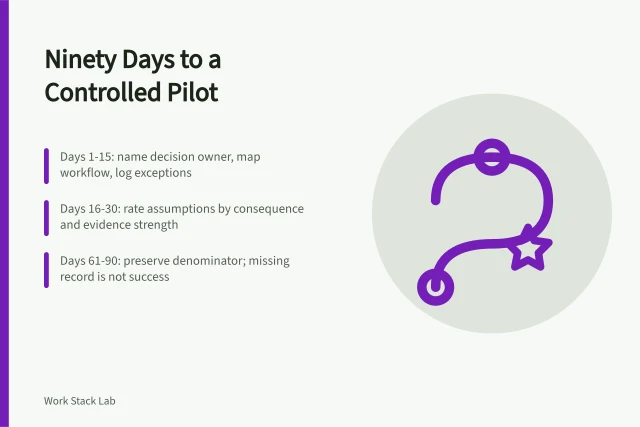
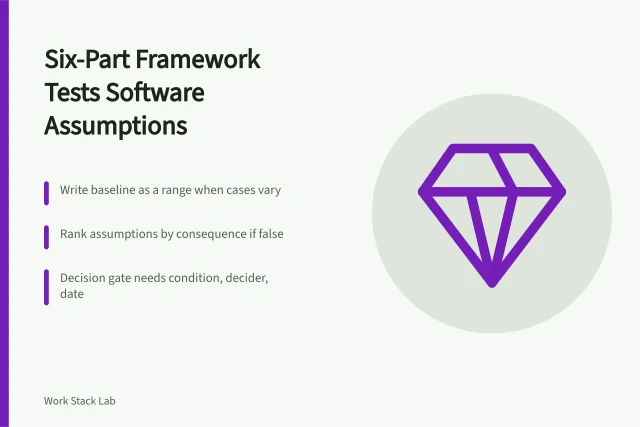
Set a baseline range where the records vary or are incomplete. Preserve the denominator and date. A later comparison should use the same event, population and calculation; otherwise an apparent improvement may be a change in measurement.
Make the strategic choices explicit
Once the workflow is understood, choose rather than accumulate. A compact decision record should answer five questions.
Which organisations and roles come first?
Select a group because its workflow and constraints are similar enough to support one proposition. Industry, employee count and location may matter, but operational traits are often more revealing: number of sites, approval layers, regulated records, existing system dependencies and access needs.
The Department for Business and Trade's SME Digital Adoption Taskforce report discusses barriers including perceived cost and difficulty, limited expertise and switching risk. It is a UK policy report rather than evidence for a specific product. Use it to test the plan for adoption friction, not to claim proven demand in England.
What will the offer include?
Separate the core outcome from the delivery wrapper. One strategy may provide a configurable subscription with self-service setup. Another may combine software with data migration, workflow design and training. The second is not merely a pricing variation: it changes staffing, liability, channel fit and the pace at which the business can take on customers.
Define the first supported integrations, data imports, operating environments and service hours. Also write down what the team will not customise. Without that boundary, early sales conversations can create a different product for every customer.
What must be true for the model to work?
List assumptions about workflow frequency, buyer authority, data availability, implementation effort, support demand and willingness to switch. Give each assumption an owner and an evidence route. The weakest high-impact assumption should be tested first.
GDS recommends using an alpha to test the riskiest assumptions through prototypes, while considering legal, contractual and legacy constraints. A commercial team can borrow that logic without copying a government delivery process. The aim is to expose a weak proposition cheaply, not to manufacture a positive result.
How will organisations encounter and buy it?
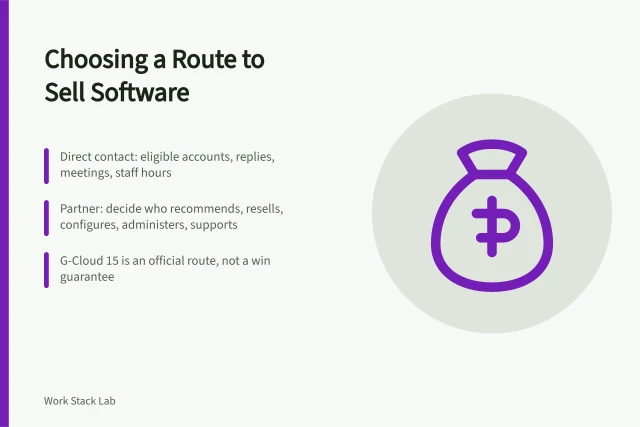
Choose a primary route to learn from before scattering effort across direct sales, content, referrals, implementation partners and procurement frameworks. A channel has to reach an identifiable role, support the evidence that role requires and leave enough margin for the work involved.
For example, an accounting platform such as Xero or Sage reaches small firms through accountant and bookkeeper partner networks. A procurement route such as the Crown Commercial Service's G-Cloud framework lists digital services for UK public sector buyers and requires published service definitions and pricing.
Direct outreach can produce detailed objections, but handling personal contact details and electronic marketing requires a lawful process. The Information Commissioner's Office explains that business-to-business electronic marketing rules differ by subscriber type, while data protection law still applies where personal data is used. Obtain qualified advice on the actual campaign rather than treating every company address alike.
Role clarity shapes a partner route. Who owns discovery, configuration, support, security questions and renewal?
The UK government's voluntary Software Security Code of Practice distinguishes developers, distributors and resellers. It sets expectations for development, deployment, maintenance and customer communication. It is not a certificate or a substitute for product due diligence, but supplies useful questions for a channel agreement.
What would cause a pause?
Agree stop conditions before enthusiasm and sunk cost distort the review. Examples: an essential data source proving unavailable, an unacceptable security exposure, implementation effort exceeding the delivery model, or repeated evidence the selected role cannot authorise a purchase.
A stop can lead to a narrower segment or a changed offer. It need not mean every earlier activity was wasted.
Turn choices into a roadmap
A useful roadmap shows decisions, evidence and dependencies, not a calendar full of features. The Service Manual's advice on developing a roadmap emphasises intent, priorities, ownership and regular updating. It also warns against locking distant work into excessive detail.
Use three planning horizons:
Three planning horizons
- NowNamed work with owner, evidence, review date
- NextOptions if present test passes
- LaterStrategic possibilities, no delivery promise
- Nownamed work with an owner, an evidence requirement and a review date.
- Nextthe options that become sensible only if the present test passes.
- Laterstrategic possibilities kept visible without implying a delivery promise.
Each roadmap item should link to an unresolved question. Replace build dashboard with test whether supervisors need one view across premises, including the prototype or data needed to decide. This language protects the team from treating output as evidence.
Dependencies deserve their own row. Data access, contract review, integration permission, accessibility work, support capacity and a customer's internal approval can all determine sequence. A roadmap that hides these conditions will look late even when the underlying assumption was wrong.
GDS guidance on planning in agile delivery recommends greater detail for near-term work and broader treatment of later activity. For a private business, the exact planning cadence should fit its staff, funding and commitments. The transferable principle is to revise the plan when learning changes the basis for it.
Build security, privacy and exit into the choice
Productivity software commonly sits between people, records and other systems. The strategy therefore needs an information map: what enters, where it is stored, which roles can see it, which suppliers receive it, how it leaves and how long each copy remains.
Information map and exit
- What enters and where it is stored
- Which roles can see it
- Which suppliers receive it
- How it leaves and how long copies remain
- Specify usable exports, audit records, deletion evidence
The ICO's current guidance on data protection by design and by default says privacy measures should be considered throughout the lifecycle. A qualified data-protection reviewer should assess the real processing, lawful basis, roles, notices, contracts and risk assessment. This guide cannot decide those matters for a particular service.
Software as a service also transfers only part of the security work. The National Cyber Security Centre's SaaS security guidance identifies customer responsibilities around configuration, identity, administration, data, monitoring and incident response. Translate that boundary into product documentation and support ownership.
Plan the exit while switching is still hypothetical. Specify usable exports, audit records, administrator handover, account closure, backups and deletion evidence. Test whether a customer can leave without reconstructing its working history by hand. A credible exit route can reduce switching anxiety and exposes technical lock-in before it becomes expensive.
Use objectives that can survive scrutiny
An objective should connect behaviour to a business consequence without claiming causation too early. Pair a near-term operating measure with a later commercial one. For instance, measure successful completion of a defined workflow before using renewal or expansion as evidence of durable value.
For every metric, record the event definition, population, exclusions, source, owner and review window. Keep product usage, customer-reported benefit, sales activity and accounting outcomes in separate columns. A rise in logins is not automatically a productivity gain, and a signed contract does not prove successful adoption.
Avoid market-share targets built from broad business counts. A national denominator says nothing about reachable organisations, eligibility, buying authority or channel capacity. Build a bottom-up planning range from named segments and observable stages, then label assumptions clearly. Financial claims and forecasts need qualified review before publication or investment use.
Govern the strategy as a decision log
Hold a short evidence review at a fixed interval. The meeting should examine what changed, which assumption is now weaker or stronger, what evidence quality supports that judgement and whether the next commitment is still justified. It is not a demonstration designed to make completed work look successful.
Maintain one decision log with this template:
| Field | Entry |
|---|---|
| Question and options | What we need to decide, plus the options considered |
| Dated evidence | Source, date and any contrary findings |
| Decision owner | Named role and qualified reviewers consulted |
| Chosen action | What we will do and its limits |
| Reopen trigger | Event or date that restarts the decision |
Keep product, commercial, security, legal and service evidence together while preserving their different meanings. A prototype can show that a workflow is understandable. It cannot establish demand, legal compliance or a profitable support model.
A practical first move
Choose one recent workflow and reconstruct it with the people who perform and approve it. Calculate a defensible baseline, list the assumptions that could defeat the proposition, and select the highest-impact uncertainty. Put only the work needed to answer that question into the first roadmap horizon.
At the review, choose among continue, narrow, change or stop. Record why.
Before you act
- Write a problem boundary in four lines.
- Follow recent completed cases through the existing workflow.
- Set a baseline range where records vary or are incomplete.
- Give each assumption an owner and an evidence route.
- Choose a primary route to learn from first.
- Record the trigger for reopening the decision.
Common questions
Why should a strategy start with one work problem rather than a software category?
The article says a broad ambition such as helping small firms work smarter leaves too many product and commercial questions unanswered. Describing who starts the work, which record moves, where it waits and who can approve it gives the plan something concrete to test.
How should a team build a baseline from completed cases?
Follow recent, completed cases through the existing workflow. Record elapsed time separately from staff effort, because a job can wait for three days while requiring only twenty minutes of work. Count re-entry, hand-offs, corrections and unresolved exceptions, and note whether evidence comes from logs, documents, observation or recollection.
What should a roadmap show instead of a calendar full of features?
A useful roadmap shows decisions, evidence and dependencies. Each item should link to an unresolved question, and dependencies such as data access, contract review, integration permission and support capacity deserve their own row. The Service Manual advises intent, priorities, ownership and regular updating.
In this guide
- Six parts of a strategy framework that expose weak productivity software assumptionsUse a six-part strategy framework to test a productivity software proposition, expose weak assumptions and make an evidence-based next decision.
- A productivity software planning template with an assumption register and decision gatesCopy this productivity software planning template to record scope, evidence, dependencies, decision gates and ownership without inventing forecasts.
- Business productivity software: choosing a direct, partner or framework routeCompare direct, partner and public-sector routes for productivity software using consistent evidence, legal checks and channel-specific limits.
- Naming the tool before the work, and six other productivity software strategy mistakesAvoid seven productivity software strategy mistakes involving scope, evidence, roadmaps, channels, security, reviews and unsupported benefit claims.
- The first ninety days of a productivity software proposition, ending in a controlled pilotPlan the first 90 days of a productivity software proposition through discovery, risk tests, a controlled pilot and a careful evidence-led review.