Strategy
Part of A productivity software strategy that measures the current route before proposing a better one
Business productivity software: choosing a direct, partner or framework route
Compare direct, partner and public-sector routes for productivity software using consistent evidence, legal checks and channel-specific limits.
What to take away
- Match the route to how a defined buyer discovers, evaluates, approves and implements business productivity software.
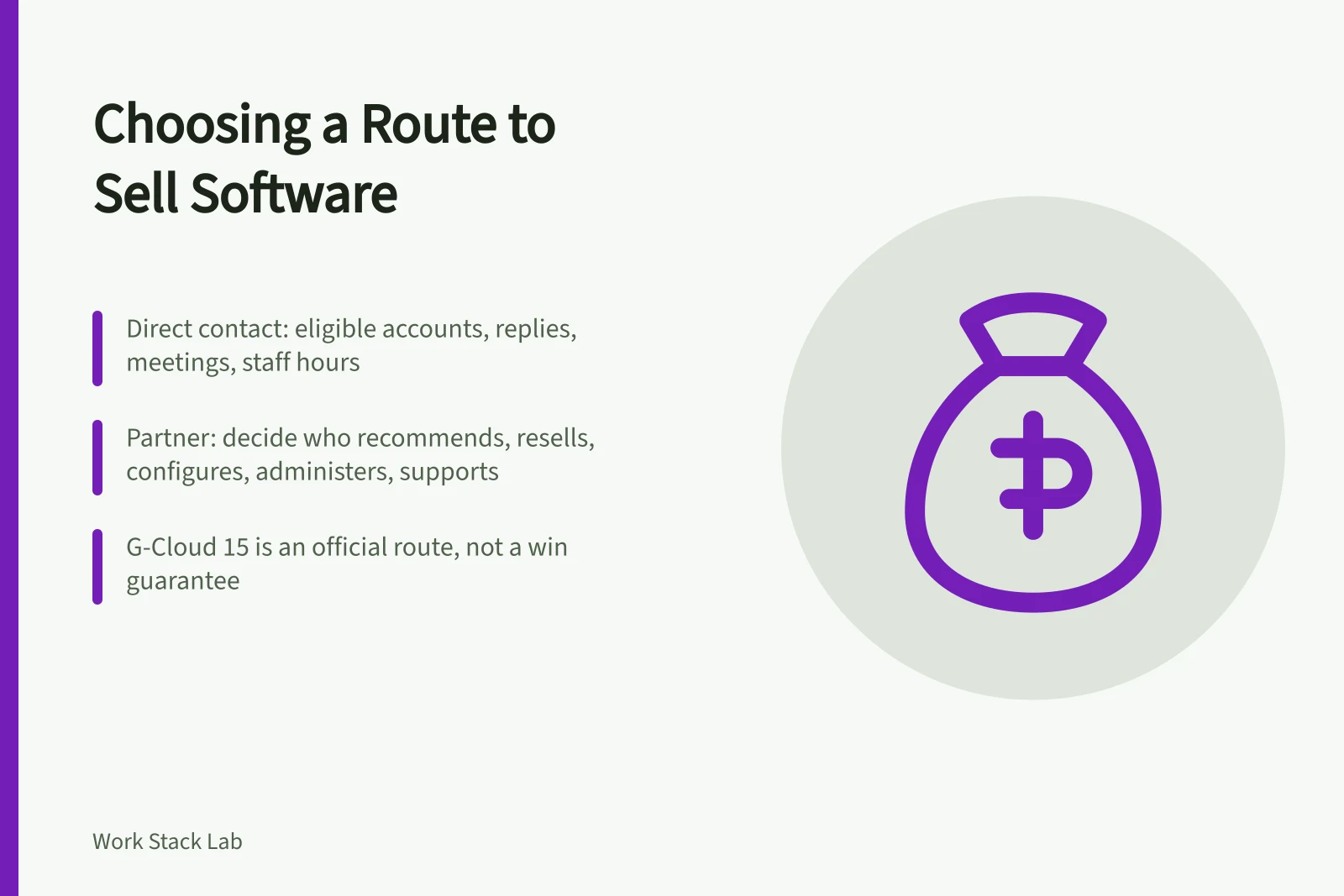
- Direct contact gives unfiltered objections but consumes founder time and requires lawful outreach. Microsoft 365, Google Workspace and Zoho Workplace can all be bought this way.
- A specialist partner adds commercial complexity, so clarify who recommends, resells, configures, administers or supports. Softcat, Computacenter, Bytes, Insight and CDW are established UK resellers and integrators.
- G-Cloud 15 is an official public-sector route, not a guarantee of winning work or fit for private firms.
A business productivity software channel strategy should match how a defined buyer discovers, evaluates, approves and implements a service. This comparison covers three routes: supplier-led contact, specialist partners and the UK's public-sector cloud framework. It does not rank them. No campaign, reseller relationship or procurement exercise was tested.
Official records for the comparison were reviewed on 5 September 2026. The criteria are buyer access, evidence required and supplier workload. They also cover control over learning, compliance exposure and measurement. Outcomes remain unknown until the team runs a bounded test with its intended audience.
Comparison at a glance
Useful when
- Direct: Microsoft 365, Google Workspace, Zoho Workplace
- The team needs first-hand objections and controls sales activity
- Partner: Softcat, Computacenter, Bytes, Insight, CDW
- Implementation trust or access to a sector matters
- Framework: G-Cloud 15 (RM1557.15), Crown Commercial Service
- The intended buyer purchases cloud services through an established procurement route
Main constraint
- Direct: Microsoft 365, Google Workspace, Zoho Workplace
- Outreach rules, list quality and founder time can limit learning
- Partner: Softcat, Computacenter, Bytes, Insight, CDW
- Incentives, support ownership and customer evidence can become blurred
- Framework: G-Cloud 15 (RM1557.15), Crown Commercial Service
- Eligibility, framework terms and buyer process restrict the route
What to measure in the same test window
- Direct: Microsoft 365, Google Workspace, Zoho Workplace
- Eligible accounts contacted, replies, qualified meetings, staff hours and days to decision
- Partner: Softcat, Computacenter, Bytes, Insight, CDW
- Partner introductions, eligible opportunities, implementation hours, support ownership and decision time
- Framework: G-Cloud 15 (RM1557.15), Crown Commercial Service
- Compliant opportunities, clarification work, tender effort, award outcome and mobilisation time
Use counts and hours, not percentages alone. Record the denominator, eligibility rule and observation period. Compare median decision time only when start and end events mean the same thing for every route.
Three routes compared
Direct
- Useful when
- First-hand objections
- Main constraint
- Outreach rules
- Measure
- Replies, meetings, hours
Partner
- Useful when
- Implementation trust
- Main constraint
- Blurred incentives
- Measure
- Introductions, support ownership
Framework
- Useful when
- Established procurement
- Main constraint
- Eligibility terms
- Measure
- Compliant opportunities, tender effort
Direct route: Microsoft 365, Google Workspace and Zoho Workplace
Direct contact gives the product team an unfiltered view of procurement questions. It suits a narrow segment where the person with the workflow problem can be identified.
Typical monthly cost per user
- £10-£13Microsoft 365 Business Standard
- £10-£12Google Workspace Business Standard
- £2-£4Zoho Workplace Standard
Research, contact, follow-up, demonstration and implementation all draw on the same team's time. Microsoft 365 Business Standard typically costs £10 to £13 per user per month on an annual plan. Google Workspace Business Standard typically costs £10 to £12 per user per month. Zoho Workplace Standard typically costs £2 to £4 per user per month.
Those ranges are typical published list prices, checked on 5 September 2026, and they are not quotes.
Electronic outreach is not a casual shortcut. The Information Commissioner's Office explains that direct-marketing rules differ between corporate subscribers and sole traders or some partnerships, while data protection requirements can still apply to named business contacts. A qualified reviewer should examine the proposed data source, lawful basis, message, opt-out and recordkeeping before launch.
Treat a meeting as evidence of access, not evidence of demand. Log the role reached, why the organisation qualified and which objection affected the proposition.
Partner route: Softcat, Computacenter, Bytes, Insight and CDW
An accountant, consultant, managed service provider or industry specialist may already support the relevant workflow. Softcat, Computacenter, Bytes, Insight and CDW are UK resellers and integrators that supply cloud software such as Microsoft 365 and Google Workspace. That context can reduce explanation, but it also introduces another commercial actor.
Clarify partner responsibilities
Does the partner recommend the product?
record recommendation role
check resale, configuration, administration or support
The five are not interchangeable. Softcat, Computacenter and Bytes are UK-listed groups. Insight and CDW are US-listed groups based in Arizona and Illinois. Softcat and Bytes lean on volume software licensing, while Computacenter, Insight and CDW carry larger managed services and integration businesses.
Partner pricing is not published as a single rate. It comes from reseller margin on licences plus charges for configuration, administration and support. Ask for that split before comparing quotes.
Decide whether the partner recommends, resells, configures, administers or supports the product. One label should not conceal five different responsibilities.
The government's voluntary Software Security Code of Practice distinguishes software developers, distributors and resellers. Use those distinctions to ask who communicates vulnerabilities, supplies updates, handles incidents and answers customer questions. The code is not certification and does not validate any particular partner.
Measure partner performance from eligible introduction to completed decision. Include internal enablement time and post-sale support, because a full diary of introductions can still be an expensive route.
Framework route: G-Cloud 15 (RM1557.15) and Crown Commercial Service
For a proposition aimed at public bodies, a Crown Commercial Service framework may be relevant. G-Cloud 15 is an official route for cloud services and related support.
Framework route checks
- Assess actual framework scope
- Check supplier obligations
- Review call-off process
- Confirm buyer requirements
- Track clarification and submission effort separately
It lists suppliers such as Microsoft, Google, Softcat, Bytes and Computacenter, alongside smaller specialists. G-Cloud 15 does not set a single price. Suppliers publish their own rates, often per user per month or per consulting day. That published rate acts as a ceiling, so a buyer can still negotiate lower.
A call-off follows set stages. The buyer searches the Digital Marketplace, filters by service and shortlists suppliers. It then makes a direct award or runs a further competition, usually inviting at least three suppliers.
Evaluation follows published criteria. Many above-threshold awards include a standstill of at least 10 calendar days before the contract is signed. A direct award can finish in a few weeks, while a further competition often takes six to twelve weeks. Value, risk and internal approvals drive the timeline.
Its existence does not mean a supplier will win work, that every English authority will use it, or that a service suited to private firms fits public procurement. Assess this route against the actual framework scope, supplier obligations, call-off process and buyer requirements.
Track clarification and submission effort separately from implementation. Do not compare a formal award stage with an informal sales conversation and call the conversion rates equivalent.
Which route fits which buyer
Three buyer types point to three routes. A small team that needs first-hand objections from a reachable group of accounts should go direct. A buyer that needs configuration, integration or sector credibility should go through a partner. A public body that must use an advertised route should use G-Cloud 15.
Select the channel that can answer the most important commercial uncertainty with acceptable risk. Set a limit on accounts, partner hours or bid effort. Define the evidence that would justify another cycle, and preserve unsuccessful cases. A channel decision should change when the intended buyer, delivery wrapper or compliance burden changes, not because another route sounds fashionable.
Illustrative planning example, not a measured result. A team tests the direct route for eight weeks, using 200 eligible accounts, one founder day a week and a £1,500 budget for data and tools. It records replies, qualified meetings and days to decision.
Divide the £1,500 plus eight founder days by the number of qualified meetings. That gives a cost per meeting to compare with a partner introduction and with a framework bid. Repeat the test only if the numbers justify it.
Before you act
- Define the intended buyer and the commercial uncertainty to resolve.
- Set a limit on accounts, partner hours or bid effort.
- Record the denominator, eligibility rule and observation period.
- Check direct-marketing rules and data protection before outreach.
- Clarify partner responsibilities for recommendations, resale, configuration, administration and support.
- Assess the framework scope, supplier obligations, call-off process and buyer requirements.
Common questions
How should a team measure channel performance?
Use counts and hours, not percentages alone, and log the role reached, why the organisation qualified and which objection affected the proposition.
What should be checked before starting electronic outreach?
The Information Commissioner's Office explains that direct-marketing rules differ between corporate subscribers and sole traders or some partnerships. Data protection requirements can still apply to named business contacts. A qualified reviewer should examine the proposed data source, lawful basis, message, opt-out and recordkeeping before launch.
What does a public-sector framework listing actually mean?
G-Cloud 15 is an official route for cloud services and related support. It lists suppliers such as Microsoft, Google, Softcat, Bytes and Computacenter.
Its existence does not mean a supplier will win work, that every English authority will use it, or that a service suited to private firms fits public procurement. Assess it against the actual framework scope, supplier obligations, call-off process and buyer requirements.