Strategy
Part of A productivity software strategy that measures the current route before proposing a better one
A productivity software planning template with an assumption register and decision gates
Copy this productivity software planning template to record scope, evidence, dependencies, decision gates and ownership without inventing forecasts.
This business productivity software planning template is a blank decision record, not a forecast model. Copy the headings into the team's approved workspace. Complete fields with dated evidence, leave unknowns visible and do not replace missing information with an optimistic estimate.
What to take away
- Treat the template as a blank decision record, not a forecast model, and keep unknowns visible.
- Separate elapsed time from work time and state whether figures came from records, observation or recollection.
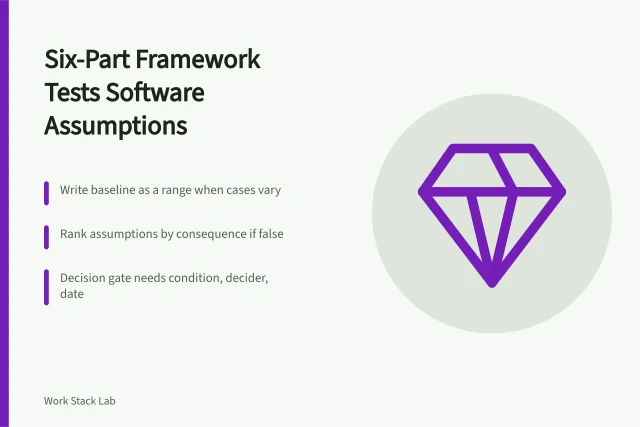
- Use the assumption register to record consequences, evidence, tests and owners for every assumption.
- List only roadmap work connected to an open question, with a pass, narrow or stop gate.
- Archive the version used for each decision so later teams can see when the plan ceased to apply.
Header
Plan owner: [name and role]
Plan header fields
- Plan ownername and role
- Decision duedate
- English market scoperegion, sector
- Workflow in scopestart to result
- Out of scopedeferred cases
- Version and last reviewidentifier, date
Decision due: [date]
English market scope: [region, sector, organisation characteristics]
Workflow in scope: [start event to completed result]
Out of scope: [cases deliberately deferred]
Version and last review: [identifier and date]
The GOV.UK business-plan guidance says a plan can clarify an idea, identify problems, set goals and measure progress. This template narrows that broad purpose to a software proposition; it is not an official government template.
Problem and baseline
Observed burden: [waiting, effort, correction, re-entry or risk]
Baseline evidence fields
- Observed burdenwaiting, effort, correction
- Baseline definitionevent, population, period
- Evidence referencesauthorised logs and notes
- Data gapswhat could not be established
- Keep elapsed time separate from work time
- State sourcerecords, observation or recollection
Baseline definition: [event, population, period, calculation and exclusions]
Evidence references: [links to authorised logs, notes or documents]
Data gaps: [what could not be established and why]
Keep elapsed time separate from work time. State whether each figure came from records, observation or recollection. Do not convert an isolated case into an average for England.
Audience and authority
Primary operator: [role and task]
Approver or buyer: [decision and spending authority]
Other affected roles: [administrator, finance, security, data subject, support]
Eligibility criteria: [facts that place an organisation in this segment]
Groups not yet represented: [gaps in research]
Official ONS business activity data can help define an industry, geography and employment band for registered enterprises or local units. Record that statistical boundary. It does not establish need for the proposed software.
Proposition and delivery boundary
Outcome offered: [one result the service is intended to support]
Core product: [functions included]
Implementation work: [migration, configuration, training and integration]
Service commitment: [support route, hours and escalation ownership]
Customer responsibilities: [configuration, administration, records and access]
Exit route: [export, account closure, retention and deletion steps]
The National Cyber Security Centre explains that SaaS customers retain responsibilities for areas such as tenant configuration, identities, data and incident response. Use the actual architecture and contract to allocate those duties; the guidance does not decide them automatically.
Assumption register
Create one row per assumption with these columns:
| Assumption | Consequence if false | Evidence held | Next test | Owner | Review date |
|---|---|---|---|---|---|
| [statement] | [high, medium or low with reason] | [dated reference] | [method] | [role] | [date] |
Do not enter no risk. If an item has not been assessed, write not assessed and assign it.
Roadmap and dependencies
List only work connected to an open question.
| Horizon | Decision to open up | Work required | Dependency | Evidence gate |
|---|---|---|---|---|
| Now | [decision] | [task] | [person, system or review] | [pass, narrow or stop condition] |
| Next | [decision] | [task] | [dependency] | [condition] |
| Later | [option, not promise] | [unknown] | [unknown] | [reason to revisit] |
Government guidance on developing a roadmap favours an adaptable statement of intent with owners and update points over a fixed catalogue of solutions. Treat that as planning advice from public services, then choose a cadence appropriate to this business.
Review block
Evidence added since last review: [references]
Contrary evidence: [references]
Decision: [continue, narrow, change or stop]
Reason and limits: [plain-language explanation]
Qualified reviews required: [commercial, financial, legal, privacy, security, accessibility]
Next commitment authorised: [scope, budget and owner]
Close the review by archiving the version used for the decision. If a later team changes the baseline or audience, it should be able to see when and why the original plan ceased to apply.
Before you act
- Copy the headings into the team's approved workspace.
- Complete fields with dated evidence and leave unknowns visible.
- Write not assessed for any unassessed assumption and assign it.
- Keep elapsed time separate from work time in the baseline.
- Record the statistical boundary from ONS data without claiming need.
- Archive the version used for the decision.
Common questions
What should I do if I cannot establish a figure for the baseline?
Leave the unknown visible and record it in the data gaps field, stating what could not be established and why. Do not replace missing information with an optimistic estimate. State whether each figure came from records, observation or recollection, and do not convert an isolated case into an average for England.
How should the assumption register handle an assumption nobody has assessed?
Create one row per assumption with columns for the statement, consequence if false, evidence held, next test, owner and review date. Do not enter no risk. If an item has not been assessed, write not assessed and assign it to an owner.
Does the NCSC guidance decide who owns security duties in a SaaS deal?
No. The National Cyber Security Centre explains that SaaS customers retain responsibilities for areas such as tenant configuration, identities, data and incident response. Use the actual architecture and contract to allocate those duties; the guidance does not decide them automatically.