Operations
Part of Running productivity software as a dependable service with an operating charter
Microsoft Planner's launch evidence reviewed at the desk, with a provisional verdict
A disclosed desk review of Microsoft Planner's public launch evidence, showing what an England-based buyer can verify and what still needs controlled testing.
This business productivity software launch review asks a narrow question: what can an England-based team establish about launching a Microsoft Planner workflow from current public documentation, and what remains unproved?
Reviewer: Codex editorial research desk. Research completed: 5 September 2026. This was desk research only. We read the cited Microsoft, NCSC and GOV.UK pages. We did not open an account, configure a plan, test permissions, integrations, export, accessibility, security, support, availability or recovery, and we did not interview users. There was no supplier contact, payment, affiliate relationship or other known conflict. The review is not a ranking or purchase recommendation.
What to take away
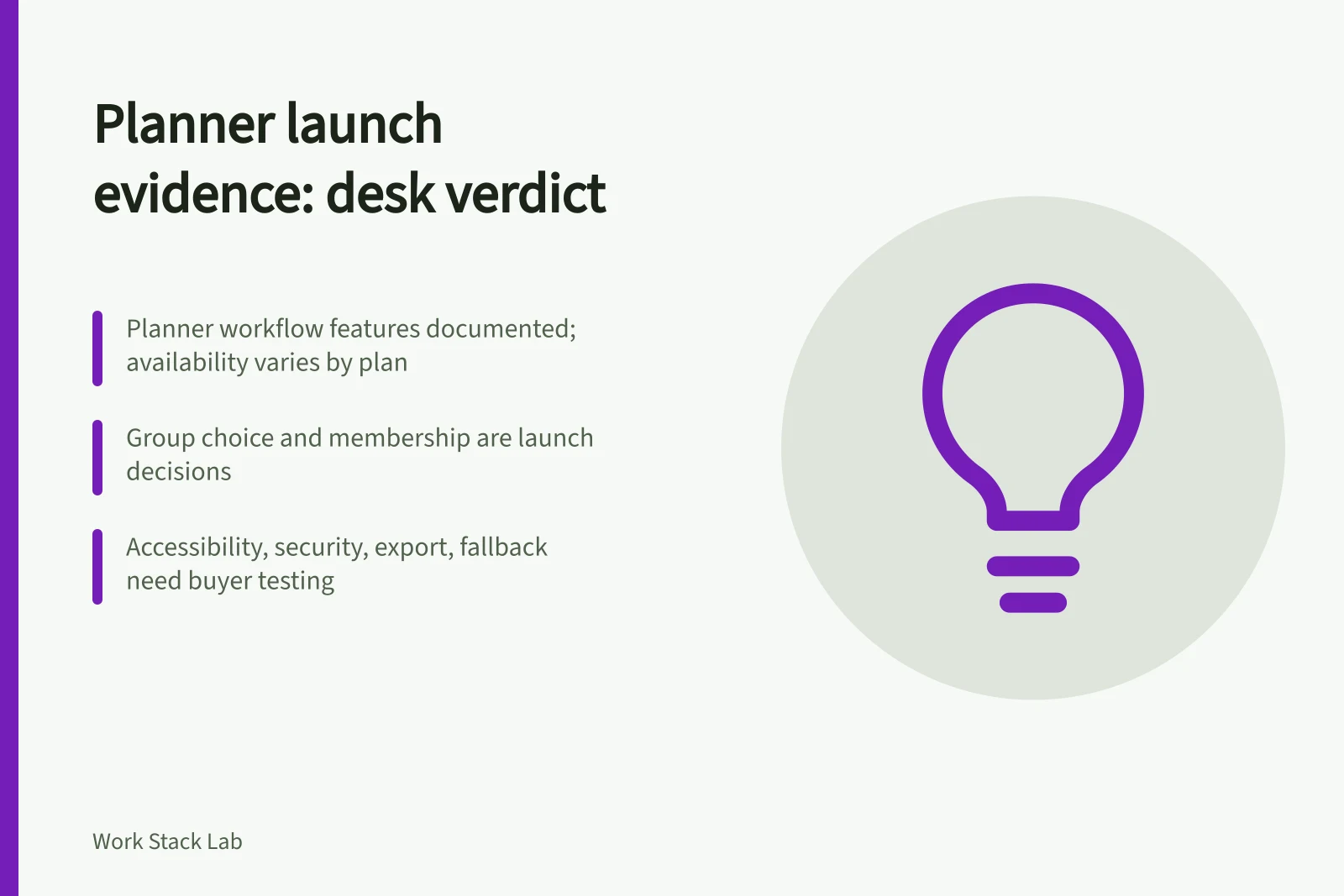
- Public documentation supports a controlled prototype of a Planner task workflow, not production approval.
- Group choice and membership are part of the launch decision, not cosmetic setup.
- Accessibility, security, export and fallback remain unproved by public feature pages alone.
- Name decision owners and keep an alternative route for priority work before launch.
- Record each test result as pass, fail or not yet evidenced, and narrow or defer if a material control is untested.
Inclusion and assessment method
Microsoft Planner is one documented task-management example, not a market winner. Inclusion needed a live first-party service description and user setup record.
Evidence labels and what they mean
Label
- Documented
- Public page describes capability
- Partly evidenced
- Some support, not fully verified
- Buyer test required
- Must be tested by buyer
Meaning
- Documented
- Partly evidenced
- Buyer test required
We assessed public evidence against five launch questions: workflow expression, access implications, quality evidence, operating ownership and fallback. Independent UK guidance set the control questions; it neither assesses nor endorses this product.
The finding labels are documented, partly evidenced and buyer test required. "Documented" means only that a cited public page describes the capability. It is not proof that the feature works for a buyer's configuration.
Workflow expression: documented, then test
Microsoft's Planner service description lists task assignments, dates, status, checklists, labels, attachments, filtering, grouping and views, with availability varying across plans and environments. Its plan-building instructions show buckets, assignments, progress, descriptions, checklists, attachments and comments.
Those records support a controlled prototype for intake-to-closure work. They do not prove that Planner expresses a particular approval rule, preserves required evidence or prevents staff from bypassing the route. The buyer should configure one representative process and test normal, rejected, overdue and reopened cases.
Access and information boundary: buyer test required
Microsoft's creation guidance says a plan can be associated with a Microsoft 365 Group and describes adding members. That relationship makes group choice and membership part of the launch decision; it should not be treated as a cosmetic setup field.
The NCSC's SaaS security guidance asks customers to examine authentication, privileged access, data protection, logging and incident arrangements. Public feature pages alone do not answer those questions for the proposed tenant, licence, identities and information. An authorised administrator and security reviewer must test them with non-sensitive sample data.
Quality and accessibility: partly evidenced
Microsoft's service description links to its wider accessibility and trust material, but this desk review did not verify a user journey with assistive technology or assess an organisation's legal obligations. The configured workflow, labels, attachments and guidance can introduce barriers that a general supplier statement will not reveal.
GOV.UK guidance on regular quality assurance recommends combining human and automated testing under normal and unusual conditions. It addresses government service teams, not Planner specifically. A buyer can use that method to record tester, environment, expected result, observed result and unresolved defects before release.
Ownership and fallback: not supplied by the product record
The documents explain features, but they cannot appoint the buyer's service owner, workflow custodian, administrator or incident lead. Nor do they establish which work must continue during a tenant, integration or connectivity problem. Those are operating-model decisions.
Before launch, name the decision owners, store supplier contacts and escalation details, and keep an alternative route for priority work outside the affected platform. Test a representative export in the purchased edition and record what is preserved. Commercial, privacy and security specialists should review current terms, processing, retention, support and exit arrangements.
Provisional verdict
The public evidence is sufficient to justify a limited, controlled prototype of a task workflow. It is insufficient to approve production use for a particular organisation. A launch decision needs configuration-level evidence for membership, information boundaries, complete workflow behaviour, accessibility, monitoring, export and fallback.
Record each result as pass, fail or not yet evidenced. If a material control remains untested, narrow the launch or defer it. That conclusion reflects the limits of this review, not a finding that Microsoft Planner is secure, insecure, suitable or unsuitable in general.
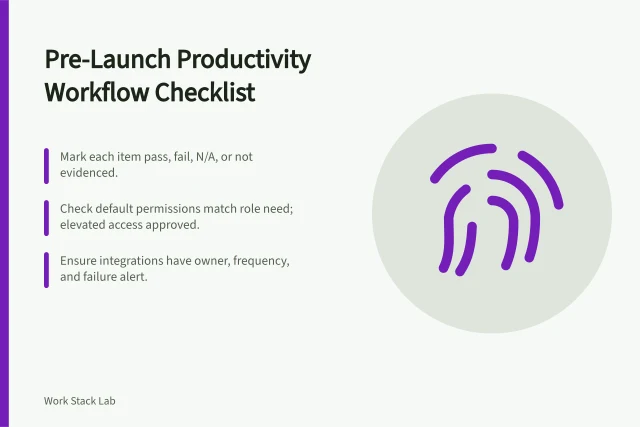
Pre-launch verification checklist
- Test representative processnormal, rejected, overdue, reopened
- Test authentication, privileged access, logging, incident arrangements
- Record tester, environment, expected result, observed result, defects
- Name decision owners, store supplier contacts and escalation details
- Test representative export in purchased edition
- Review terms, processing, retention, support and exit arrangements
Before you act
- Configure one representative process and test normal, rejected, overdue and reopened cases.
- Test authentication, privileged access, logging and incident arrangements with non-sensitive sample data.
- Record tester, environment, expected result, observed result and unresolved defects before release.
- Name decision owners and store supplier contacts and escalation details.
- Test a representative export in the purchased edition and record what is preserved.
- Review current terms, processing, retention, support and exit arrangements.
Common questions
What did the review actually test?
The review was desk research only. The team read cited Microsoft, NCSC and GOV.UK pages. They did not open an account, configure a plan, test permissions, integrations, export, accessibility, security, support, availability or recovery, and did not interview users. There was no supplier contact, payment or affiliate relationship.
What does the documented label prove?
Documented means only that a cited public page describes the capability. It is not proof that the feature works for a buyer's configuration. The records support a controlled prototype for intake-to-closure work, but they do not prove that Planner expresses a particular approval rule or preserves required evidence.
What should happen before a launch decision?
A launch decision needs configuration-level evidence for membership, information boundaries, complete workflow behaviour, accessibility, monitoring, export and fallback. Record each result as pass, fail or not yet evidenced. If a material control remains untested, narrow the launch or defer it. Public evidence alone is insufficient to approve production use.